
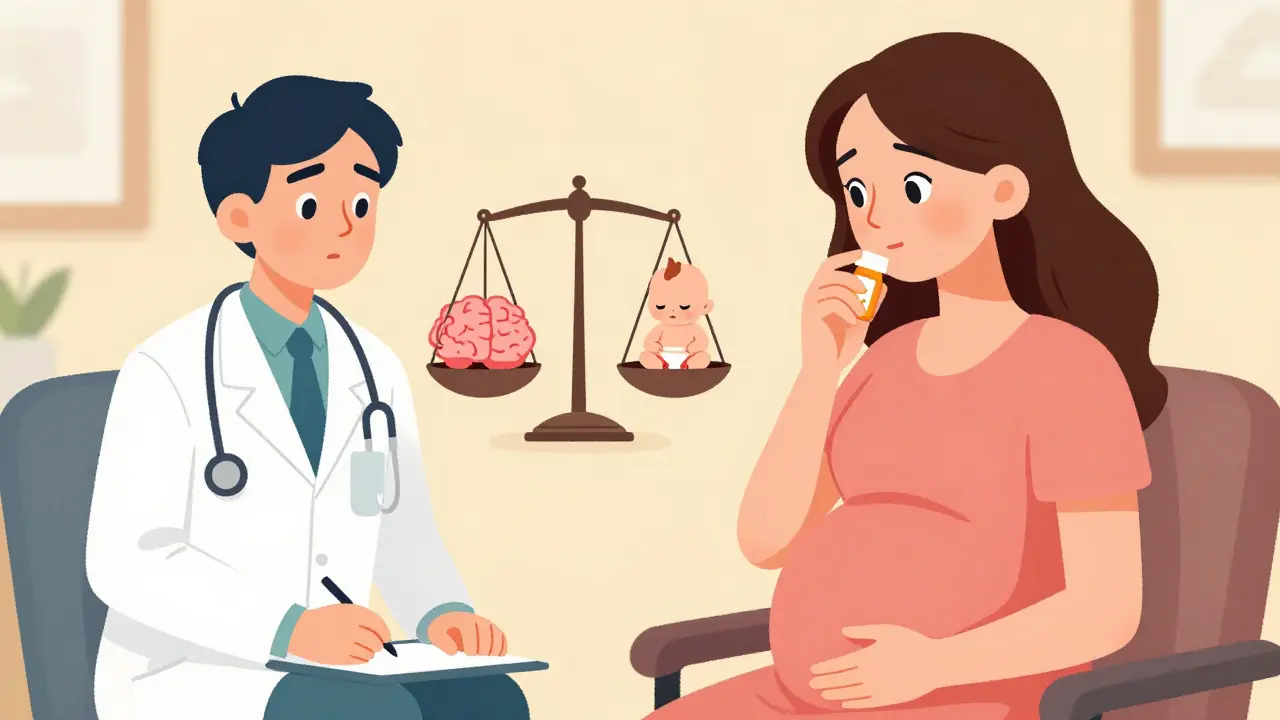

Every year, over 1 in 10 pregnant women in the U.S. experience depression or anxiety disorders. But taking antidepressants during pregnancy? That's a tough call. Many women worry about risks to their baby, while others fear the consequences of untreated mental health issues. Let's look at the real facts about SSRIs during pregnancy.
SSRIs are a class of antidepressant medications that increase serotonin levels in the brain by blocking its reabsorption. Selective Serotonin Reuptake Inhibitors (SSRIs) work by inhibiting serotonin reuptake transporters, thereby increasing serotonin availability in the synaptic cleft, which modulates mood regulation. First introduced in the late 1980s, SSRIs like sertraline (Zoloft) and fluoxetine (Prozac) are commonly used to treat depression and anxiety. During pregnancy, these medications help manage mental health conditions that could otherwise lead to serious complications like preterm birth or suicide risk.
Key Risks: What Science Says
Research shows SSRIs carry some risks, but they're often smaller than people think. Let's break down the facts:
- Persistent Pulmonary Hypertension of the Newborn (PPHN): This rare lung condition affects 1-2 in 1,000 newborns normally. With third-trimester SSRI use, the risk rises to 3-6 per 1,000. That's still very low overall.
- Preterm birth: Studies show 12.5% of SSRI-exposed pregnancies result in preterm birth compared to 9.5% in non-exposed depressed women. However, when controlling for depression severity, this difference nearly disappears.
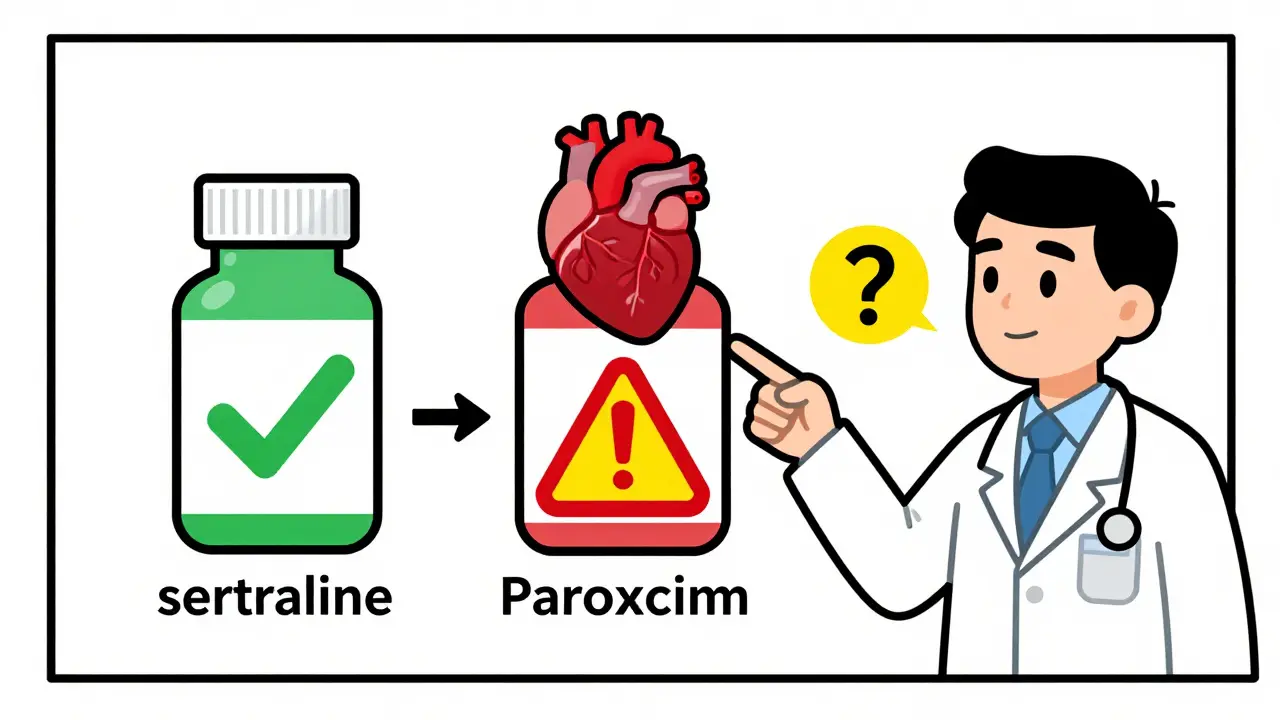
- Congenital heart defects: Paroxetine (Paxil) carries a 1.5-2x higher risk of septal heart defects. Absolute risk increases from 0.5% to 0.7-1.0%. Other SSRIs like sertraline show no significant increase.
- Neonatal Adaptation Syndrome: About 30% of SSRI-exposed newborns experience temporary symptoms like jitteriness or feeding issues, but these usually resolve within two weeks.
The FDA the U.S. Food and Drug Administration replaced pregnancy categories with the Pregnancy and Lactation Labeling Rule (PLLR) in 2015. Most SSRIs now have clear risk summaries. A 2020 JAMA Psychiatry a peer-reviewed medical journal analysis of 1.8 million Nordic births found no substantial increase in major congenital malformations with SSRI exposure (absolute risk 2.8% vs 2.5% in non-exposed).
Which SSRIs Are Safest During Pregnancy?
| SSRI | Risk of Cardiac Defects | PPHN Risk | First-Line Recommendation |
|---|---|---|---|
| Sertraline (Zoloft) a selective serotonin reuptake inhibitor used for depression and anxiety | Low risk | 3-6 per 1,000 | Yes |
| Fluoxetine (Prozac) a long-acting SSRI with potential for accumulation in fetal tissue | Minimal risk | 4-5 per 1,000 | Second-line |
| Paroxetine (Paxil) an SSRI with higher risk of cardiac defects | 1.5-2x higher risk | 3-6 per 1,000 | Avoided |
| Citalopram (Celexa) an SSRI with moderate safety profile | Low risk | 3-5 per 1,000 | Considered |
| Escitalopram (Lexapro) the active enantiomer of citalopram | Low risk | 3-5 per 1,000 | Considered |
According to the American College of Obstetricians and Gynecologists (ACOG) a professional organization for obstetricians and gynecologists 2023 guidelines, sertraline is the first-line choice due to its lower PPHN risk and extensive safety data. Paroxetine should be avoided in the first trimester because of cardiac defect risks. Sertraline has a placental transfer rate of 60-70% with cord blood to maternal blood ratios of 0.9-1.1, meaning it crosses the placenta but not excessively.
Why Stopping SSRIs Can Be Riskier Than Continuing
Many women consider stopping SSRIs during pregnancy out of fear. But research shows this is often riskier. A 2022 JAMA Psychiatry trial found that discontinuing SSRIs leads to a 4.3-fold higher risk of depressive relapse-92% of women who stopped relapsed compared to just 21% who continued treatment.
Untreated depression has severe consequences:
- Suicide accounts for 20% of pregnancy-related deaths in the U.S. (CDC 2022 data)
- Preterm birth risk increases by 2.2-fold without treatment
- 25% of untreated depressed pregnant women use substances versus 8% in treated groups
- Maternal attachment scores are 30% lower in untreated cases
When analyses control for depression severity (confounding by indication), the risks associated with SSRIs diminish significantly. For example, the preterm birth risk linked to SSRIs drops to OR 1.08 (95% CI 0.92-1.27) when depression severity is accounted for. This means the underlying depression, not the medication, is often the main driver of complications.
Talking to Your Doctor: A Step-by-Step Guide
Your healthcare provider should guide your decision. Here's how to prepare:
- Bring your current medication list and mental health history: Include past treatments, dosages, and how well they worked.
- Discuss specific risks based on your pregnancy stage: The first trimester carries the highest risk for birth defects, but treatment at any stage is better than untreated depression.
- Ask about sertraline as first-line treatment: It has the lowest PPHN risk among SSRIs and extensive safety data.
- If considering stopping, never do it abruptly: Tapering over 4-6 weeks reduces withdrawal symptoms like dizziness (42%), nausea (38%), and "brain zaps" (29%).
- Request regular PHQ-9 depression screenings: Weekly checks during tapering help monitor symptoms.
- Consider genetic testing: Some doctors test for CYP2D6 and CYP2C19 metabolizer status, which affects how your body processes SSRIs. About 40% of the population has genetic variations impacting medication metabolism.
The Society for Maternal-Fetal Medicine (SMFM) a professional organization focused on maternal-fetal health states: "The available data consistently show that SSRI use during pregnancy is not associated with congenital anomalies, fetal growth problems, or long-term developmental problems." They recommend continuing effective pre-pregnancy regimens rather than switching medications.
Frequently Asked Questions
Is sertraline safe to take during pregnancy?
Yes. Sertraline is the most recommended SSRI for pregnancy. Studies on over 1.8 million births show no substantial increase in birth defects. It has the lowest PPHN risk among SSRIs. The cord blood to maternal blood ratio is 0.9-1.1, meaning it crosses the placenta but not excessively. ACOG and SMFM both list sertraline as first-line therapy.
Should I avoid paroxetine during pregnancy?
Yes, especially in the first trimester. Paroxetine carries a 1.5-2x higher risk of cardiac septal defects (absolute risk increase from 0.5% to 0.7-1.0%). The 2023 ACOG guidelines specifically advise avoiding paroxetine during pregnancy due to this risk. If you're currently taking it, talk to your doctor about switching to sertraline before conception if possible.
Will my baby have developmental issues from SSRIs?
Current evidence doesn't support a strong link. A 2021 Lancet study adjusted for family history and found no significant association between SSRIs and autism (OR 1.02, 95% CI 0.95-1.10). While some studies show increased depression rates in children by age 15 (28% vs 12% in non-exposed), these findings may reflect underlying maternal mental health rather than medication effects. The NIH's 2023 review concludes "the risks of SSRIs in pregnancy are justified when juxtaposed next to the risks of more severe untreated mental illness."
Can I stop SSRIs abruptly during pregnancy?
No. Abrupt discontinuation causes withdrawal symptoms in 73% of cases, including dizziness (42%), nausea (38%), and "brain zaps" (29%). The ACOG recommends a stepwise taper over 4-6 weeks with weekly PHQ-9 depression screenings. Stopping SSRIs increases relapse risk by 4.3-fold-92% of women who stop relapse versus 21% who continue treatment.
What's the safest time to take SSRIs during pregnancy?
The first trimester carries the highest risk for birth defects, so if possible, switch to sertraline before conception. However, treatment at any stage is better than untreated depression. The NIH's 2023 review states that for women with moderate to severe depression, "the benefits of continuing SSRIs generally outweigh potential risks" at any pregnancy stage. Regular monitoring for gestational hypertension (8.5% in SSRI users vs 6.2% controls) is recommended after 20 weeks.
How do genetic factors affect SSRI use during pregnancy?
Variations in CYP2D6 and CYP2C19 genes affect how your body processes SSRIs. About 40% of people have metabolizer status that impacts medication effectiveness or side effects. While routine testing isn't standard yet, your doctor may consider it if you've had poor responses to previous treatments. This helps tailor dosing to minimize risks.


14 Comments
The FDA's data on SSRIs is clearly manipulated.
Big Pharma has been hiding the truth for decades.
They're pushing these drugs on pregnant women to make more money.
The government is in cahoots with pharmaceutical companies.
You should be worried about the long-term effects on children.
I've read studies showing SSRIs cause autism, but they're not publishing the real data.
This is a massive cover-up.
It's important to weigh the risks.
Untreated depression has serious consequences like preterm birth and suicide risk.
SSRIs like sertraline have been studied extensively and are generally safe.
Always consult with your doctor for personalized advice.
You're not alone in this.
Sertraline is safest. Talk to your doctor.
America's healthcare is being taken over by foreign drug companies.
SSRIs are dangerous.
FDAs in cahoots with them.
Protect our children from corporate greed.
Hey y'all, dat on SSRIs is solid. Sertraline's cord bloood ratio is 0.9-1.1, so it crosses placenta but not too much. Untreated depression has 2.2x preterm birth risk. Talk to your doc. #MentalHealthMatters
It's really important to prioritize mental health during pregnancy! 🌟 SSRIs like sertraline have been studied well and are generally safe. Untreated depression can cause more harm than the meds. Let's support each other and talk to doctors! 💕 #MentalHealthMatters
I agree with the data. SSRIs are generally safe, but everyone's different. My friend took sertraline and had a healty baby. Talk to your doctor! 😊 But also, don't forget to take care of yourself. Mental health is just as important as physical health. 💯
Big Pharma is pushing SSRIs to make profits.
FDAs covering up the risks.
We need to protect our children from this corporate agenda.
SSRIs are dangerous during pregnancy.
FDAs data is unreliable.
Big Pharma controls studies.
You should avoid them. Period.
Taking SSRIs during pregnancy is tough but many women do it safely.
Sertraline is best option.
Talk to your doctor and don't be afraid to ask questions.
You're doing great! 😊
Research shows SSRIs are safer than untreated depression.
Sertraline has lowest risks.
Consult specialist for personalized advice.
SSRIs during pregnancy are dangerous trend.
Government and Big Pharma pushing drugs despite risks.
Protect children from corporate influence.
Data is clear.
SSRIs are a scam! Big Pharma is poisoning pregnant women and babies.
FDAs in on it.
They're hiding data on autism and birth defects.
Wake up people! Massive cover-up.
I've read studies proving it but they're not published because of pharma lobby.
Don't take these drugs!
OH MY GOD, I just can't believe how dangerous SSRIs are during pregnancy!!! It's terrifying!!! The FDA is completely ignoring the risks!!! I've read so many studies that show birth defects and autism, but they're not telling us the truth!!! It's a conspiracy!!! I'm so worried for all the pregnant women out there!!! Someone needs to do something!!! This is horrible!!!