


Side Effect Timing Estimator
Enter Your Symptoms
Results
Enter your medication details to see if your symptoms align with typical time-to-onset patterns.
Key Timing Patterns
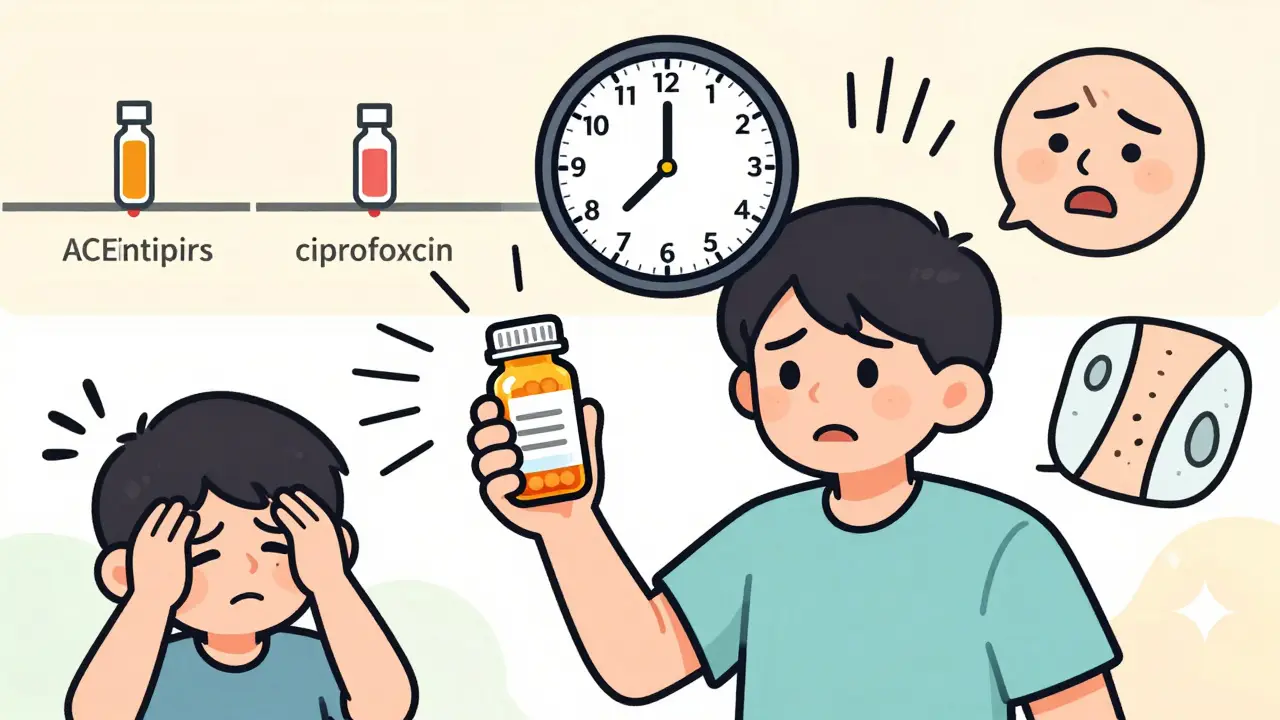
Fast-Onset (Hours to Days)
ACE inhibitors: Angioedema within hours (but can occur up to 6 months)
Ciprofloxacin: Median 2 days for nerve pain
Acetaminophen: Liver damage within 24 hours if overdosed
Mid-Term (Days to Weeks)
Statins: Median 1-4 weeks for muscle pain
Antiepileptics: Median 19-31 days for dizziness
Antibiotics: Rashes after 3-7 days
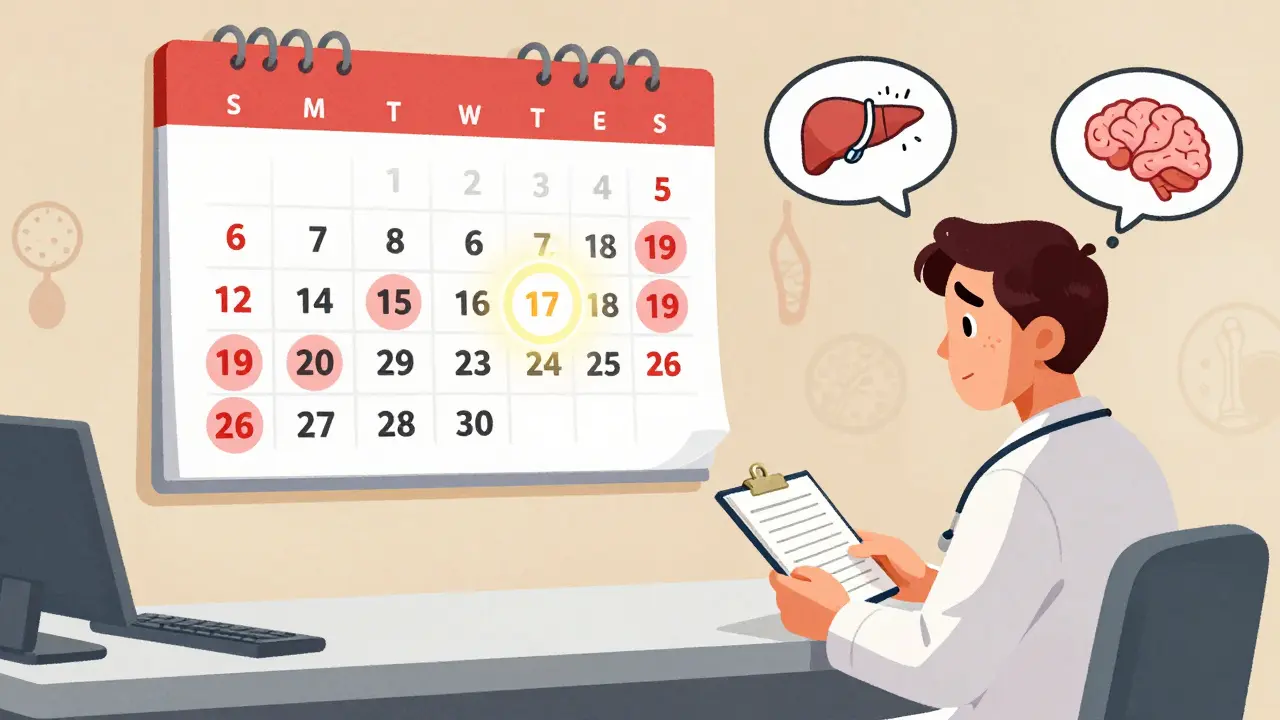
Delayed (Weeks to Months)
Interferon: Median 526 days for neuropathy
Natalizumab: Median 141.5 days for neuropathy
Drug-induced hepatitis: Median 42 days (range 20-117)
Ever started a new medication and weeks later, you still can’t tell if that headache, muscle ache, or nausea is from the drug or just bad luck? You’re not alone. Many people blame side effects on pills without realizing that time-to-onset-when symptoms actually appear after taking a drug-is one of the clearest clues doctors have to separate real reactions from coincidence.
Some side effects hit fast. Others creep in slowly, sometimes months later. Knowing the typical timing for each drug class isn’t just for pharmacologists-it’s critical for patients and clinicians trying to make sense of strange new symptoms. A rash that shows up on day 3? Probably the antibiotic. Swelling that hits at month 5? Could be your blood pressure pill. Misunderstanding this timing leads to unnecessary drug switches, misdiagnoses, and even dangerous delays in treatment.
Fast-Onset Reactions: Hours to Days
Some drugs trigger reactions almost immediately. These are usually the easiest to spot because the link between taking the pill and feeling sick is clear.
Take ACE inhibitors like lisinopril or enalapril. A small percentage of users develop angioedema-a sudden swelling of the face, lips, or throat. Histamine-driven cases show up within hours. But here’s the twist: the kind caused by bradykinin buildup (which is more common) can appear anytime from the first week to six months later. That’s why doctors often miss it. One patient in a 2022 case report developed life-threatening throat swelling four months after starting lisinopril. Her doctor didn’t connect it until she found research showing delayed onset is possible.
Another classic fast-reactor is ciprofloxacin, a common antibiotic. Studies show its most troubling side effect-peripheral neuropathy (nerve pain, tingling, numbness)-hits median at exactly 2 days. Women experience it even faster than men, with a median of 2 days versus 4. That’s not a fluke. In a 2025 analysis of over 12,000 cases, ciprofloxacin had the steepest early risk curve of any drug studied. If you start feeling pins and needles within 48 hours of taking it, stop and call your doctor. Don’t wait.
Even acetaminophen (Tylenol) can cause liver damage within 24 hours if taken in overdose. But for most people taking the right dose, this isn’t a concern. The key is knowing the window: if you’re sick within a day of starting a new drug, think acute reaction. If it’s after a week, think something else.
Mid-Term Reactions: Days to Weeks
Many side effects don’t show up until you’ve been taking the drug for a while. This is where confusion sets in. Patients often assume they’re fine because they made it past day 3 or 5. But for some drugs, the real risk kicks in later.
Statins like atorvastatin and rosuvastatin are a prime example. Most people think muscle pain starts right away. But data from a 2021 JACC study shows the median onset is actually between 1 and 4 weeks. Even more surprising? A crossover trial with 60 patients who had quit statins due to muscle pain found that 55% felt better within 3 days of stopping-whether they were on the real drug or a placebo. That points to a strong nocebo effect: the expectation of side effects can make you feel them, even without the drug.
Then there are antiepileptics like pregabalin and gabapentin. Used for nerve pain and anxiety, these often cause dizziness, fatigue, or brain fog. A review of over 1,200 patient reviews on Drugs.com found that 58% reported these symptoms within the first week. Research confirms this: pregabalin’s median time-to-onset is 19 days, gabapentin’s is 31. If you’re on one of these and feel off after 10 days, it’s not “just stress.” It’s likely the drug.
Antibiotics beyond ciprofloxacin also follow this pattern. Common ones like amoxicillin or doxycycline can trigger rashes or diarrhea after 3-7 days. That’s why many doctors tell patients to finish the full course even if they feel better-it’s not just about killing bacteria. It’s about letting the body reset and avoiding delayed reactions.
Delayed Reactions: Weeks to Months
Some side effects are so slow to appear that they’re mistaken for aging, stress, or the original illness. These are the most dangerous because they slip under the radar.
Interferon beta-1a, used for multiple sclerosis, has one of the longest known time-to-onset patterns. For peripheral neuropathy, the median is over 526 days-nearly 1.5 years. That’s longer than most patients stay on the drug. If you’ve been on it for a year and suddenly feel numbness in your feet, it could be the medication. Most doctors wouldn’t suspect it.
Natalizumab, another MS drug, causes peripheral neuropathy with a median onset of 141.5 days. Again, that’s almost five months. Patients often assume their MS is worsening, not realizing the drug might be the cause.
Then there’s drug-induced hepatitis. For most drugs, liver damage from idiosyncratic reactions shows up around 42 days after starting. But the range? 20 to 117 days. That’s nearly four months. If you’ve been on a new medication for 10 weeks and now feel unusually tired, have dark urine, or your skin is yellowing, get your liver checked. Don’t wait.
Why Timing Matters More Than You Think
It’s not just about knowing when side effects start-it’s about using that knowledge to make smarter decisions.
For example, if you develop joint pain two days after starting a new statin, it’s unlikely to be the drug. Statins rarely cause joint pain that fast. But if it’s two weeks in? That’s a red flag. Similarly, if you’ve been on an antidepressant for six weeks and suddenly feel restless or anxious, it could be akathisia-a known side effect with a typical onset of 2-6 weeks. If you’d known that, you wouldn’t have assumed it was your depression getting worse.
Electronic health records now include algorithms that flag potential drug reactions based on timing. Mayo Clinic reported a 22% increase in detecting adverse events after adding TTO-based alerts in 2022. That’s not magic-it’s just better use of data.
And here’s the kicker: the longer you take a drug, the more likely you are to develop a delayed reaction. That’s why the FDA says adverse events within 30 days of starting treatment get special attention-but reactions after that? They’re often ignored. That’s a gap in care.

What You Can Do
You don’t need to be a doctor to use this knowledge. Here’s how to protect yourself:
- Ask your pharmacist when side effects typically start for your new prescription. Most can tell you the common windows.
- Keep a symptom log. Note the date you started the drug and any new symptoms. Even small changes matter.
- Don’t assume it’s “just you”. If a symptom appears within the known window for your drug, bring it up. Don’t wait for it to get worse.
- Don’t stop cold without talking to your doctor. Some reactions need gradual tapering. Others need testing, not just stopping.
One woman in Perth told her doctor her chronic fatigue was “just aging.” She’d been on levothyroxine for six months. Her TSH was normal, so no one looked further. But her fatigue started exactly 14 weeks after starting the pill. That’s the classic window for drug-induced thyroid dysfunction. She got tested, found she was over-replaced, and her energy returned within weeks.
What’s Changing Now
Technology is catching up. The FDA’s Sentinel Initiative now analyzes 47 million patient records to build drug-class-specific time-to-onset baselines. Pharmaceutical companies are using machine learning to predict when side effects will appear based on a drug’s chemical structure. By 2025, the NIH’s All of Us program will start adding genetic data to these models, helping predict who’s most at risk for delayed reactions.
But the biggest shift? Regulatory agencies. Since 2020, the European Medicines Agency has required Weibull distribution analysis for all new drug applications. That’s the math behind predicting how risk changes over time. The U.S. is catching up. By 2030, nearly all drug labels will include time-to-onset data-not just frequency.
For now, you’re your own best advocate. If you’re on a new medication and something feels off, check the timing. It might not be your body failing. It might be the drug’s fingerprint.
How soon after starting a drug do side effects usually appear?
It depends on the drug. Some side effects start within hours-like angioedema from ACE inhibitors. Others appear in days, like nerve pain from ciprofloxacin (median 2 days). Muscle pain from statins often begins after 1-4 weeks. Liver damage or nerve issues from some drugs can take months. There’s no universal timeline, but each drug class has a typical window researchers have mapped.
Can a side effect appear after I stop taking the drug?
Yes, but it’s rare and usually not classified as a direct drug reaction. Most adverse events are tracked only during active treatment. However, some drugs can cause lasting damage or delayed immune responses that surface weeks after stopping. For example, some antibiotics can trigger autoimmune reactions that show up after discontinuation. If symptoms appear after stopping, it’s still worth mentioning to your doctor-it might be a delayed effect.
Why do some people get side effects faster than others?
Genetics, age, liver and kidney function, and sex all play a role. For example, women experience ciprofloxacin-induced nerve pain faster than men-median 2 days versus 4. Older adults process drugs slower, so side effects can linger longer. Some people have genetic variants that make them more sensitive to certain drugs. That’s why timing isn’t just about the drug-it’s about your body’s unique response.
Are side effects more likely if I’ve taken the drug before?
Not necessarily. For most side effects, the first exposure is when risk is highest. But for immune-related reactions-like certain rashes or liver damage-your body may need time to develop sensitivity. So, a reaction might appear on the second or third course, even if the first was fine. This is called sensitization. If you’ve had a reaction before, avoid the drug unless absolutely necessary.
Can I trust my doctor if they say my symptom isn’t from the drug?
Trust but verify. Doctors rely on patterns, but they’re not always aware of the latest time-to-onset data. If your symptom matches a known window for your drug and your doctor dismisses it, ask: “What’s the typical onset for this side effect?” or “Is there research showing this reaction can be delayed?” Bring up the data yourself. Many patients have changed their treatment plans by simply asking the right question.







15 Comments
So let me get this straight: if I get a headache 3 days after taking statins, it’s not the drug? Just my imagination? 🙄
I’ve been on gabapentin for 28 days and my brain feels like wet cotton. Everyone told me to ‘give it time’-turns out, the drug was just waiting for me to forget when I started it. 🤯
The temporal dynamics of pharmacokinetic-induced adverse events are profoundly underutilized in clinical decision-making frameworks. The Weibull distribution modeling, as mandated by the EMA since 2020, provides a statistically robust paradigm for risk stratification-particularly for idiosyncratic hepatotoxicity, which exhibits a median latency of 42 days (IQR: 20–117). This necessitates systematic temporal tracking in EHRs.
Wow. A whole article about when side effects start. Groundbreaking. Next up: 'Water is wet when you drink it.'
People just don’t take responsibility anymore. If you’re feeling weird after a drug, maybe you’re just weak. Or stressed. Or lazy. 😔
This is actually really helpful. I had a rash after 10 days on amoxicillin and thought it was just allergies. Now I realize it’s probably the drug. Thanks for the clarity.
just write down when you start the med and what you feel. no need to be a scientist. your body talks. you just gotta listen.
I’m so sick of Big Pharma hiding this stuff. My mom got liver damage from a blood pressure med and they didn’t even tell her it could take months. #CoverUp
Thank you for sharing this. I’ve been on levothyroxine for 5 months and just felt so tired-I thought it was menopause. Now I’m going to ask my doctor about timing. 💛
OMG I’ve been on cipro for 48 hours and my feet are tingling 😱 I’m calling my doctor right now. Thank you for this post!! 🙏❤️
The data on statin-induced myalgia being delayed is critical. Many patients discontinue prematurely due to the nocebo effect. A structured rechallenge protocol, even with placebo, can clarify causality.
I appreciate the nuance here. Timing matters-but so does listening to your body. Not every symptom is the drug. Not every delay is safe. Balance is key.
This is exactly the kind of information that should be on every prescription label. Not just 'may cause dizziness'-but 'most often appears between days 10–31'. We need transparency.
If you’re not tracking your symptoms when you start a new med, you’re playing Russian roulette with your health. Stop blaming yourself. Start logging. Your future self will thank you.
i took that interferon thing for ms and got numbness after 18 months. doc said 'its just your ms getting worse'... turns out it was the drug. i wish i knew this sooner.