

Emotional Blunting Assessment Tool
How Emotional Blunting Affects You
This tool helps you understand if you might be experiencing emotional blunting side effects from SSRIs. Based on your responses, you'll receive personalized information about next steps.
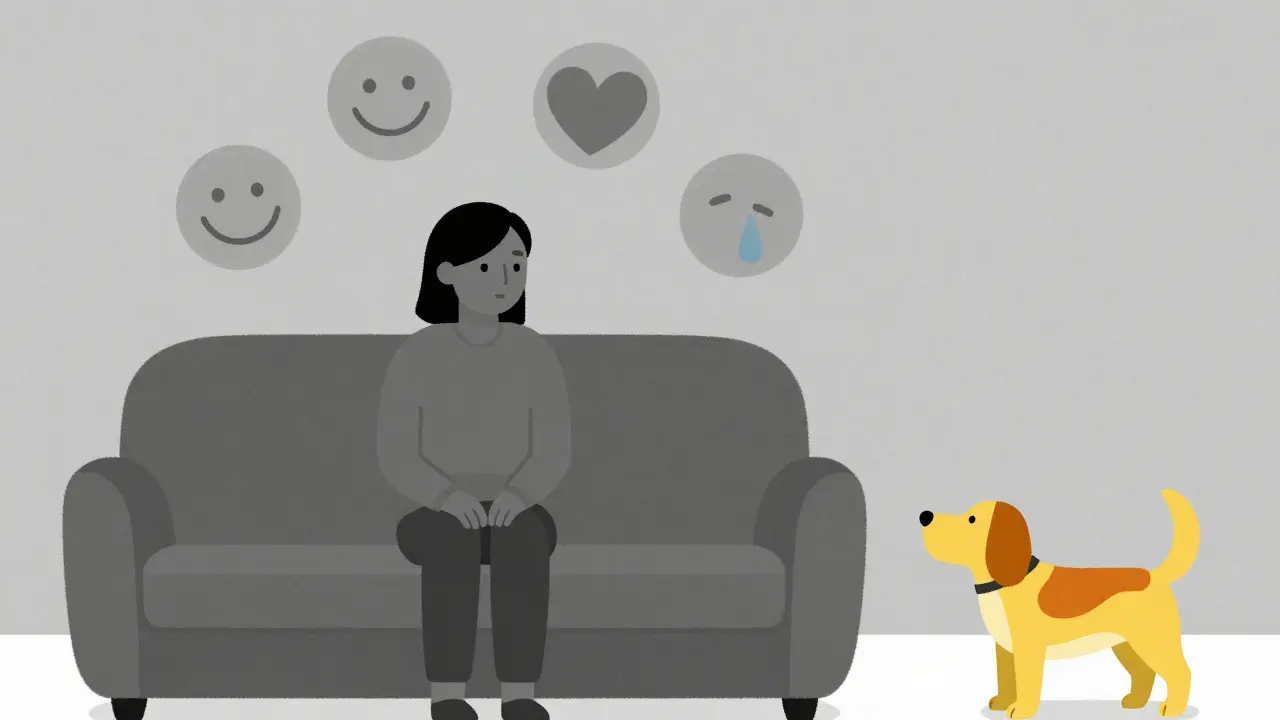
When you start taking an SSRI to treat depression, you expect to feel better. But for many people, something unexpected happens: they don’t feel much at all. Not just sadness - but joy, anger, love, even grief. It’s not laziness. It’s not being cold. It’s a real, measurable change in how the brain processes emotion. This is called emotional blunting, and it affects between 40% and 60% of people taking SSRIs like sertraline, escitalopram, or fluoxetine. If you’ve noticed you’re not crying at movies anymore, your dog’s excitement doesn’t move you, or you just feel… flat - you’re not alone. And you’re not broken. This is a documented side effect with real solutions.
What Emotional Blunting Actually Feels Like
Emotional blunting isn’t just being “numb.” It’s a narrowing of your emotional world. You might still laugh at a joke, but it doesn’t reach you the way it used to. You can recognize that your friend is upset, but you don’t feel it in your chest. You don’t get that warm rush when you see your child smile. Even negative emotions like anger or sadness feel distant - like you’re watching your life through glass.
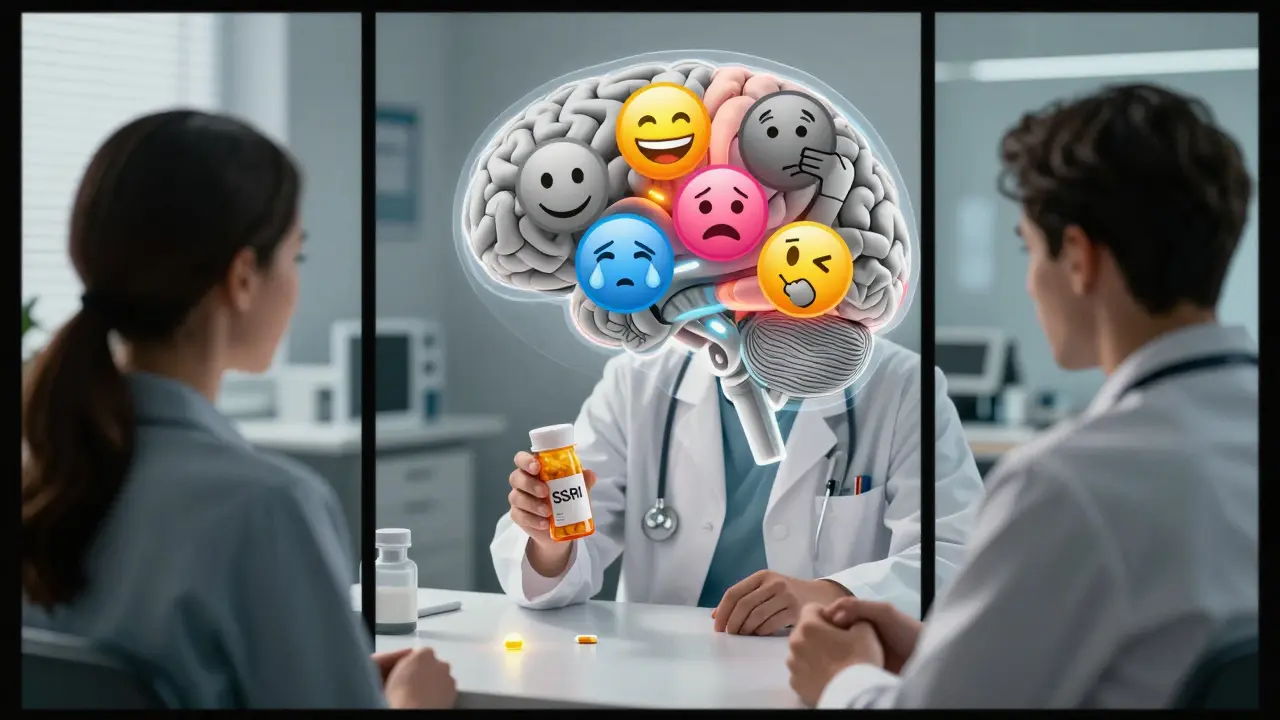
Research from the University of Cambridge in 2022 found that SSRIs interfere with a brain process called reinforcement learning. That’s the system that helps us learn what feels good and what doesn’t. When it’s dampened, everything - good and bad - loses its punch. It’s not that you’re depressed again. It’s that your brain has lost its emotional contrast. You’re not in a dark place. You’re in a gray one.
People describe it in startlingly similar ways. On Reddit, one user wrote: “I stopped crying at sad movies and didn’t feel joy when my dog greeted me - just a flat nothing.” On Drugs.com, 32% of escitalopram users mentioned emotional blunting in their reviews. That’s more than one in three. Meanwhile, bupropion - a different kind of antidepressant - only had 12% of users reporting similar issues.
Why This Happens - And Why It’s Not Just “In Your Head”
Some doctors still treat emotional blunting like a minor complaint - something you should just “tough out.” But it’s not. Brain imaging and behavioral studies show real changes. Unlike cognitive side effects (like memory lapses), emotional blunting targets what scientists call “hot cognition”: decision-making shaped by emotion, moral judgment, and how we connect with others.
SSRIs increase serotonin in the brain, which helps reduce overwhelming anxiety and despair. But serotonin doesn’t just dial down pain - it also turns down pleasure. The same mechanism that stops panic attacks can also stop you from feeling the warmth of a hug. It’s not a bug - it’s a side effect of how these drugs work.
And it’s not rare. The NHS reported over 8.3 million antidepressant prescriptions in England in 2021/22. If 40% of those users experience blunting, that’s more than 3 million people living with this quiet, isolating side effect. Yet only 38% of psychiatrists routinely screen for it. That means most people suffer in silence, thinking it’s just “part of getting better.”
How It Affects Your Life - Beyond the Mood
Emotional blunting doesn’t just change how you feel. It changes how you live.
- Relationships suffer. Partners report feeling like they’re dating a ghost. One man on an antidepressant forum wrote: “My wife left me because I couldn’t express love anymore.”
- Creativity fades. Artists, writers, and musicians often say their inspiration dries up. Music doesn’t move them. Writing feels mechanical.
- Therapy becomes harder. If you can’t feel your emotions, you can’t talk about them. Many people stop therapy because they feel like they’re just going through motions.
- Self-awareness drops. You might not even realize you’ve lost something - until you see someone else laugh with their whole body, or cry openly, and you realize: I haven’t done that in months.
And here’s the cruel twist: for some people, this numbness was the only thing that made survival possible. One user on PsychForums said: “I needed the numbness to function during my worst episode.” That’s valid. But if you’re past the crisis - and still feeling empty - then it’s time to reconsider.
Switching SSRIs Won’t Help
Many people try switching from one SSRI to another - fluoxetine to sertraline, sertraline to escitalopram - hoping the new one won’t cause the same numbness. But research shows it won’t.
A 2021 review in Frontiers in Psychiatry found no meaningful difference in emotional blunting rates between SSRIs. Escitalopram, paroxetine, fluoxetine - they all carry the same risk. That’s because they all work the same way: they flood the brain with serotonin. The drug name doesn’t matter. The mechanism does.
And if you’ve been on an SSRI for months or years, your brain has adapted. Simply swapping one for another won’t reset that. It’s like trying to fix a broken stereo by changing the power cord - same problem, different brand.
The Best Solution: Switch to Bupropion
There’s one antidepressant that doesn’t cause emotional blunting - and it’s not even an SSRI. It’s bupropion.
Bupropion works differently. Instead of targeting serotonin, it boosts dopamine and norepinephrine. That’s the brain’s motivation and energy system. And because it doesn’t over-saturate serotonin, it doesn’t dull emotions.
A 2022 meta-analysis in the Journal of Clinical Psychiatry looked at 1,243 patients who switched from SSRIs to bupropion. Seventy-two percent reported significant improvement in emotional responsiveness. Many said they could feel joy again - even if it was slow to come back.
Here’s how it works in practice:
- Your doctor reduces your SSRI dose by 25-50% over 2-4 weeks.
- You start bupropion at 150mg daily (extended-release).
- Over 4-6 weeks, your SSRI is fully phased out.
This approach, called augmentation or switch therapy, works in 63% of cases when done under supervision. And it’s safer than quitting cold turkey - which can trigger withdrawal symptoms like brain zaps, dizziness, or nausea in up to 80% of people.
Other Options - And Why They’re Less Reliable
There are other antidepressants with lower emotional blunting risk, but they’re not as proven:
- Mirtazapine - May help because it blocks certain serotonin receptors. But it causes weight gain and drowsiness, which can be worse than the numbness.
- Agomelatine - Works on sleep rhythms. Limited data. Not available in the U.S.
- Vortioxetine - Promises better emotional function, but most studies were funded by the manufacturer. Independent data is scarce.
None of these match bupropion’s track record. And none are approved as first-line alternatives for emotional blunting - yet.
What to Do If You’re Feeling Blunted
If you’re on an SSRI and you’ve noticed this change, here’s what to do next:
- Don’t quit cold turkey. Withdrawal can be dangerous. Always taper with medical help.
- Track your emotions. Keep a simple log: “Today, did I feel joy? Sadness? Anger? Did I react to anything?”
- Ask your doctor about bupropion. Bring the research. Say: “I think I’m experiencing emotional blunting. Can we talk about switching?”
- Request screening. The American Psychiatric Association now recommends asking every SSRI user about emotional responsiveness at every visit. You have the right to be asked.
And if your doctor says, “It’s just part of the treatment” - push back. You’re not asking for a miracle. You’re asking to feel human again.

What’s Changing - And What’s Coming
This isn’t just an old problem. It’s a growing one.
The global antidepressant market hit $14.7 billion in 2022. SSRIs make up 70% of those prescriptions. And with more people taking them longer - often for years - emotional blunting is becoming a public health issue.
Regulators are starting to act. The European Medicines Agency added emotional blunting to SSRI labels in May 2022. The National Institute of Mental Health just funded a $4.2 million study to find biological markers for it. And by 2026-2028, new antidepressants designed to avoid this side effect could hit the market.
But you don’t have to wait. The tools to fix this are here now.
Frequently Asked Questions
Is emotional blunting the same as depression?
No. Depression involves sadness, hopelessness, fatigue, and loss of interest. Emotional blunting is different - it’s a flatness where you can’t feel anything, good or bad. You might still function, but you’re emotionally disconnected. Some people with depression develop blunting from SSRIs. Others feel blunted even after their depression lifts. They’re related but not the same.
Can emotional blunting go away on its own?
Sometimes, yes - but not reliably. A small number of people report gradual improvement after months or years. But for most, the numbness persists as long as they’re on the SSRI. Waiting it out is risky. If you’re unhappy with how you feel, you don’t have to accept it. There are better options.
Does bupropion work for depression too?
Yes. Bupropion is FDA-approved for major depressive disorder. It’s especially helpful for people with low energy, lack of motivation, or fatigue - symptoms that SSRIs sometimes worsen. It doesn’t work for everyone, but for those struggling with emotional blunting, it’s often the best alternative.
How long does it take to feel emotions again after switching?
Most people notice small changes within 2-4 weeks. Full emotional recovery can take 6-12 weeks. It’s not instant. You might feel like you’re slowly turning on a dimmer switch. But the return of joy, even in small doses, is a strong sign the treatment is working.
Are there any risks to switching from an SSRI to bupropion?
The biggest risk is stopping the SSRI too fast - which can cause withdrawal. But when done gradually under medical supervision, switching is very safe. Bupropion can cause insomnia or jitteriness in some people, but these usually fade in a week or two. It’s also not recommended if you have a history of seizures or eating disorders.
Next Steps
If you’re on an SSRI and feel emotionally flat:
- Write down when you first noticed the change - and what you miss most.
- Bring this article to your next appointment. Say: “I think I’m experiencing emotional blunting. Can we discuss switching to bupropion?”
- Don’t settle for numbness as the price of stability. You deserve to feel - fully - again.





15 Comments
I felt this so hard. Started on sertraline for anxiety, thought I was finally okay... then realized I hadn't cried in 18 months. Not even at my grandma's funeral. Didn't even notice until my sister said, 'You're so calm now.' Like, thanks? But I miss feeling things. Switched to bupropion last year. Took 3 months. Now I laugh at dumb dog videos again. And yes, I cried at a commercial for pet food. Worth it.
This is so true i never knew it had a name. I just thought i was becoming a robot. My husband said i dont react to anything anymore. Not happy, not sad. Just... blank. I was scared to say anything because i thought it was my fault. Glad to know its not just me
Ugh I HATE when doctors just shrug this off like it's 'just part of the process'. I was on escitalopram for 3 years and I felt like a zombie who forgot how to feel. My therapist asked me once if I still liked my favorite song and I said 'I don't know, I haven't listened in months.' That's when I knew I had to get off. Bupropion saved my soul. I'm not just surviving anymore. I'm living. And yes, I cried during a Pixar movie last week. I'm not ashamed.
Bupropion works.
I switched 6 months ago and honestly? The first time I felt my dog's excitement again, I just sat on the floor and hugged him for 10 minutes. No words. Just tears. I didn't even realize how much I missed that. 🥹 Also, I started painting again. I forgot I used to love it. Bupropion didn't fix me overnight, but it let me come back to myself. Thank you for writing this.
i was on zoloft for 5 years. i thought i was just getting older or something. i stopped noticing the seasons, stopped caring about birthdays, stopped feeling proud of my own work. it was like my emotions got muted. i tried switching ssris, same thing. then my doc said try bupropion. i was skeptical. but after 2 months? i heard a song on the radio and i actually felt something. not like 'oh that's nice' but like my chest got tight and i had to pull over. that's when i knew. it's not magic. it's just... real again.
As someone who's helped 12 patients through this exact switch, I can't stress this enough: emotional blunting isn't 'side effect' material - it's a quality-of-life crisis. SSRIs aren't evil, but they're blunt instruments. Bupropion? It's like replacing a fog machine with a spotlight. People come back to life. I've seen artists paint again, parents hug their kids like they mean it, partners hold hands without feeling like roommates. This isn't just medical - it's human.
This is why America needs to stop being so soft. People take these meds because they're lazy. You want to feel? Go outside. Get a dog. Work out. Cry if you want to. Stop blaming a pill for your lack of willpower. Bupropion? Sounds like another crutch. Just suck it up.
The real question isn't whether bupropion works - it's why we let serotonin become the default. Why isn't dopamine a first-line option? Why do we assume emotional regulation = serotonin modulation? This is neurobiological reductionism at its worst. We treat depression like a broken faucet, not a complex system. SSRIs fix one leak and drown the whole house. We need systemic thinking, not pharmacological band-aids.
Bupropion? Please. You're just trading one addiction for another. Next you'll be saying we should all be on Adderall for motivation. This is how Big Pharma keeps us hooked. You think you're 'feeling human' again? Nah. You're just chemically wired for dopamine highs. You're not healing - you're trading numbness for mania. Wake up.
I've been on bupropion for 2 years now. The first time I felt my own anger - not just 'I'm annoyed' but full-on, fists-clenched, 'I'm done with this' anger - I was terrified. But then I realized: that was me. Not a pill. Not a numb zone. Me. And that felt terrifyingly right. I didn't know I'd lost my capacity for righteous rage until it came back. I'm not 'fixed.' I'm just whole again.
this post made me cry i think its the first time in 2 years lol. i was on lexapro for 4 years and i thought i was just being a grown up. no drama no feels no nothing. my best friend said i was like a ghost at her wedding. i didnt even realize i was smiling on autopilot. switched to bupropion 5 months ago. i still forget to feel sometimes but now i know its not me. its the meds. and i can fix it. thank you
I'm a psych NP. Let me cut through the noise: emotional blunting is underdiagnosed because it doesn't show up on a PHQ-9. Patients say 'I'm not sad' - so docs assume they're fine. But they're not happy either. Just hollow. Bupropion isn't a magic bullet, but it's the most reliable tool we have for restoring affect. And yes - if you're on an SSRI and feel like a robot, you're not broken. You're just on the wrong drug.
I switched last year. Took 8 weeks. I remember the first time I laughed so hard I snorted. It was a YouTube video of a cat falling off a couch. I didn't think I still had it in me. Now I cry at dog rescue ads. And I still get anxious sometimes. But I feel. That's the difference.
Honestly, this is why I stopped trusting American psychiatry. We treat mental health like a car manual. 'Add serotonin, fix mood.' But humans aren't circuits. We're poetry. You can't quantify joy. And if your 'treatment' turns you into a walking spreadsheet - you're not healing. You're being erased. Bupropion? Maybe. But we need a whole new paradigm. Not just a different pill.