
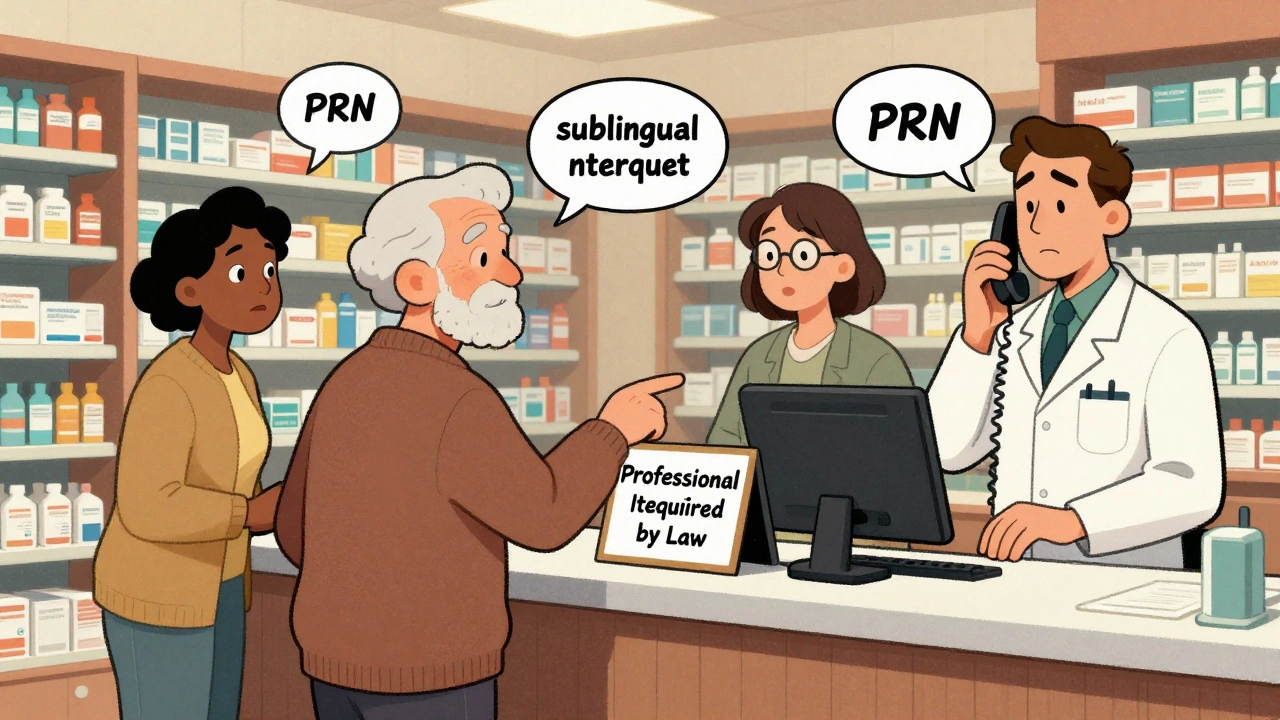

When you or a loved one is prescribed a new medication, understanding how to take it isn’t just helpful-it’s life-saving. But if English isn’t your first language, that understanding can vanish in a rush of medical jargon, unclear instructions, or rushed conversations. Federal law says you have the right to a professional interpreter during medication counseling-and pharmacies are required to provide it at no cost to you.
Why Language Services for Medication Counseling Are Required by Law
It’s not a courtesy. It’s the law. Since 1964, Title VI of the Civil Rights Act has protected people from discrimination based on national origin, including language. In 2010, Section 1557 of the Affordable Care Act made it even clearer: any healthcare provider receiving federal funds-like most pharmacies that bill Medicare or Medicaid-must offer free language assistance services. The stakes are high. A 2012 study from UC San Francisco found that patients with limited English proficiency (LEP) are three times more likely to make dangerous medication errors when no interpreter is available. These aren’t small mistakes. They’re missed doses, wrong dosages, dangerous drug interactions-all because instructions weren’t clearly understood. States like California have gone even further. Their SafeRx program requires pharmacies to use professional interpreters during every prescription counseling session, medication review, or when collecting critical patient info. And they’ve translated standard directions (SIGs) into five languages: Spanish, Chinese, Korean, Russian, and Vietnamese. These aren’t just printed sheets-they’re legally approved, medically accurate translations.What Counts as a Qualified Interpreter?
Not every bilingual person is qualified to interpret medical instructions. A friend who speaks both English and your language? A pharmacy tech who took a semester of Spanish? These aren’t enough-and using them increases the risk of serious errors by 49%, according to a 2021 JAMA Pediatrics study. A qualified interpreter must:- Have formal training in medical terminology (minimum 40 hours)
- Pass a certification exam in healthcare interpreting
- Understand confidentiality rules under HIPAA and Section 1557
- Be able to interpret both literally and culturally-translating not just words, but meaning
Three Ways to Get an Interpreter at the Pharmacy
There are three main ways pharmacies provide interpreters. Each has pros and cons.1. Telephonic Interpreting (Phone)
This is the most common. You ask for an interpreter, and the pharmacist calls a service like RxTran or LanguageLine. The interpreter connects in under 30 seconds most of the time. It’s cheap-around $2.50 to $3.50 per minute-and available 24/7. But it’s not perfect. A 2019 study at Massachusetts General Hospital found 32% of elderly LEP patients struggled with phone-only interpretation. No visual cues. No gestures. No way to see if the patient is confused. If you’re dealing with complex instructions-like insulin dosing or multiple medications-it’s not ideal.2. Video Remote Interpreting (VRI)
This is becoming the middle ground. The pharmacist uses a tablet or computer to connect with an interpreter via video. You can see facial expressions, hand gestures, and lip movements. It’s more effective than phone calls and less expensive than sending someone in person. By 2023, 65% of healthcare facilities had adopted VRI, according to CMS data. It costs $3 to $5 per minute. Many pharmacies now use this method for routine counseling. But tech can fail. A 2023 CMS report found 28% of VRI attempts had connection issues, audio delays, or poor video quality.3. On-Site Interpreters
This is the gold standard. A trained interpreter walks into the pharmacy, sits with you and the pharmacist, and translates everything in real time. You get full context, body language, and immediate clarification. A 2022 survey by the National Association of Chain Drug Stores found 78% of pharmacists reported better patient understanding with on-site interpreters. But they’re expensive-$45 to $75 per hour-and hard to find outside big cities. Most community pharmacies can’t afford to keep one on staff.
How to Request an Interpreter (Step by Step)
You don’t have to wait for the pharmacist to offer. You have the right to ask. Here’s how:- Speak up early. As soon as you arrive at the pharmacy, say: “I need a professional interpreter for my medication counseling.” Don’t say “Can someone help?” or “My daughter speaks English.”
- Be specific. Tell them your language: “I need a Spanish interpreter,” or “I need someone who speaks Vietnamese.” If you’re unsure what language to name, say “I need an interpreter who speaks my native language.”
- Refuse family members. Even if your child or neighbor offers to help, say no. They’re not trained. They might skip words, misunderstand terms, or soften warnings out of fear. This puts your health at risk.
- Wait for the service. The pharmacy must provide the interpreter at no cost. If they say “We’ll do it later,” or “We’re busy now,” insist. You have a legal right to this service before you leave with your prescription.
- Ask for documentation. After the session, ask if the interpreter’s name, language, and service type were recorded. Pharmacies are required to document this for billing and compliance.
What to Do If the Pharmacy Refuses
If the pharmacy says “We don’t have one,” or “We can’t afford it,” they’re breaking the law. Here’s what to do:- Ask to speak to the pharmacist-in-charge or store manager.
- Remind them: “Under Section 1557 of the Affordable Care Act, I’m entitled to a free professional interpreter.”
- If they still refuse, file a complaint with the U.S. Department of Health and Human Services (HHS) Office for Civil Rights. You can do it online at hhs.gov/ocr (no phone number needed).
- Report the incident to your state’s Board of Pharmacy. California, New York, and Illinois have active complaint systems for language access violations.

What’s Changing in 2025
New rules took effect January 1, 2025:- AI translation tools (like Google Translate or chatbots) are now prohibited for use on prescription labels or medication counseling. Human review is mandatory.
- CMS raised reimbursement rates for interpreter services for children in Medicaid/CHIP programs from 50% to 75%. This means more pharmacies will invest in better services.
- California is adding translations for Tagalog and Arabic, after finding that 22% of LEP patients speak languages not covered by their current five.
Real Patient Experiences
On Reddit, a pharmacist with 12 years of experience wrote: “RxTran connects fast, but their Mandarin interpreters often don’t know terms like ‘sublingual’ or ‘PRN.’ We’ve had to train them on the fly.” In California, Vietnamese patients praised the clarity of their translated directions. But Russian speakers reported confusion-grammar structures didn’t match how medical terms are used in Russian. That’s why translations must be culturally adapted, not just word-for-word. A 2023 Kaiser Health News report revealed that 67% of pharmacy staff try to handle LEP patients without interpreters when busy. That’s why 23% of LEP patients say they didn’t understand critical warnings.Final Advice: Don’t Let Language Be a Barrier
You’re not being difficult. You’re being smart. Medication errors kill. And language barriers are one of the most preventable causes. If you’re unsure how to take a pill, what side effects to watch for, or how it interacts with your other meds-ask for an interpreter. Say it clearly. Demand it. And if you’re helping someone else, speak up for them. This isn’t about convenience. It’s about safety. And the law is on your side.Do I have to pay for a translator at the pharmacy?
No. Federal law requires pharmacies that accept federal funds (including Medicare and Medicaid) to provide professional interpreters at no cost to you. You cannot be charged for this service.
Can I use my child or friend as an interpreter?
While you can choose to use them, pharmacies are not allowed to rely on family members or untrained bilingual staff. Using them increases the risk of serious medication errors by nearly 50%. Always request a qualified professional interpreter instead.
What if the pharmacy doesn’t have an interpreter available right away?
The pharmacy must provide an interpreter before you leave with your prescription. If they don’t have one on-site, they must use phone or video interpreting immediately. You are not required to take your medication without proper counseling.
Are all languages covered?
Yes. Federal law requires services for any language, not just the most common ones. While some states like California have pre-translated materials for five languages, pharmacies must still arrange interpreters for any language you speak-even rare ones.
How do I know if the interpreter is qualified?
A qualified interpreter will be introduced by name and role. They should use medical terminology correctly (e.g., ‘subcutaneous,’ ‘adverse reaction’) and not paraphrase or omit warnings. If you’re unsure, ask: ‘Are you certified to interpret in healthcare settings?’
Can I request written materials in my language?
Yes. Pharmacies must provide written materials-like directions, warnings, and side effect lists-in your language if they’re available. In California, these are standardized and legally approved. Ask for them before you leave.
What if I’m not fluent in English but need to refill a prescription?
You still have the right to an interpreter during every counseling session-even for refills. Changes in dosage, new warnings, or drug interactions can happen with refills. Never assume you already know everything.



11 Comments
Wow. Just... wow. You actually think this is about safety? No. It's about liability. Pharmacies are terrified of lawsuits, so they throw interpreters at every LEP patient like it's a compliance checkbox. Meanwhile, the real problem? Most people don't even know they're entitled to this-so they just nod and take the pill. And then? They die quietly. And nobody gets fined until the coroner's report says 'medication error due to miscommunication.' So yeah-enforce the law. But don't pretend this is altruism. It's corporate damage control.
Interesting read. In the UK, we don't have this exact system, but NHS pharmacies often use phone interpreters too. I've seen it work well-when the staff actually care. The real issue isn't the tech, it's the attitude. If the pharmacist treats you like a burden, no interpreter will fix that.
So now we're paying $5 a minute so a stranger can tell Mrs. Nguyen that 'take one pill twice a day' means 'don't take it with grapefruit'? Brilliant. Next they'll charge us for a therapist to explain what 'side effects' means. We're turning healthcare into a sitcom.
They say 'federal law' but who really enforces this? The same people who let Big Pharma price gouge insulin? This is theater. A distraction. While you're demanding interpreters, they're quietly replacing pharmacists with AI kiosks. The real enemy isn't language-it's capitalism. And it doesn't care if you live or die.
Important point about qualified interpreters-so many people think 'bilingual = interpreter.' It's not even close. Medical interpreting requires training in anatomy, pharmacology, and ethics. I trained as one in my home country before moving here. The difference between a certified interpreter and a cousin who took high school Spanish? Life and death. If you're a pharmacy owner, invest in training. If you're a patient, demand certification. Don't settle for 'they speak some English.'
YESSSSS. This is the kind of post that makes me wanna hug the internet. 🤗 You didn’t just write an article-you wrote a battle cry. I’ve seen my abuela nodding along while the pharmacist rushed through her meds like it was a drive-thru. I’ve yelled. I’ve cried. I’ve filed complaints. And guess what? They finally gave her a real interpreter last month. It’s not easy-but you’re not alone. Keep speaking up. We’ve got your back.
My mom is from Mexico and has been on 7 different meds in the last year. Every time we went to the pharmacy, they'd hand her a pamphlet in Spanish and say 'it's all here.' But half the terms didn't even translate right. 'Sublingual'? They wrote 'bajo la lengua'-but in her region, that means 'under the tongue'-not 'hold it there for 30 seconds.' When we finally got a real interpreter? She started asking questions. Turns out she was swallowing her blood pressure pill like candy. We almost lost her. This isn't bureaucracy. It's survival.
Let’s be real: this whole system is a performative compliance theater designed to make wealthy white liberals feel better about themselves while the real healthcare crisis-understaffing, corporate greed, and the erosion of the pharmacist-patient relationship-rages on. You think a $5-per-minute video call fixes systemic neglect? Please. The only reason this law exists is because someone got sued after a 78-year-old Haitian woman died from mixing her anticoagulant with her new antibiotic. And now? We have a whole industry built around guilt. Meanwhile, the same pharmacies that pay interpreters are still selling vape pens to teens and insulin at $300 a vial. This isn’t justice. It’s PR.
Language is power. And power is never given. It’s taken.
So now we’re gonna pay for interpreters for every language under the sun but still let pharmacies sell nicotine gum to 14-year-olds? This country’s priorities are a joke. First they make you pay $200 for a pill, then they charge your tax dollars to explain it to you in Tagalog. What a time to be alive.
Just got back from my local CVS. Asked for a Vietnamese interpreter for my dad’s new diabetes med. They said ‘we’ll call one.’ 22 minutes later, the line cut out twice. The pharmacist just handed him a printed sheet and said ‘you’re good.’ My dad nodded. He didn’t understand a word. I’m filing a complaint tomorrow. This isn’t just inconvenient-it’s dangerous. And honestly? Most staff don’t even know the law. They’re just winging it. We need mandatory training. Not just for interpreters-for everyone behind the counter.