



Anticholinergic Safety Checker for Men with BPH
How This Tool Works
Based on the American Urological Association (AUA) guidelines, this tool helps determine if anticholinergics (like oxybutynin or solifenacin) are safe to take based on your prostate health metrics.
Important: This tool is for informational purposes only and should not replace professional medical advice. Always consult with your urologist before making decisions about your treatment.
Men with an enlarged prostate often face a tough choice: manage urgent, frequent urination, or risk being unable to urinate at all. Anticholinergic drugs like oxybutynin and solifenacin are commonly prescribed for overactive bladder, but for men with benign prostatic hyperplasia (BPH), these medications can push the bladder past its breaking point. The result? Acute urinary retention - a sudden, painful inability to empty the bladder that often ends in emergency catheterization.
How Anticholinergics Work - and Why They’re Dangerous for Prostate Patients
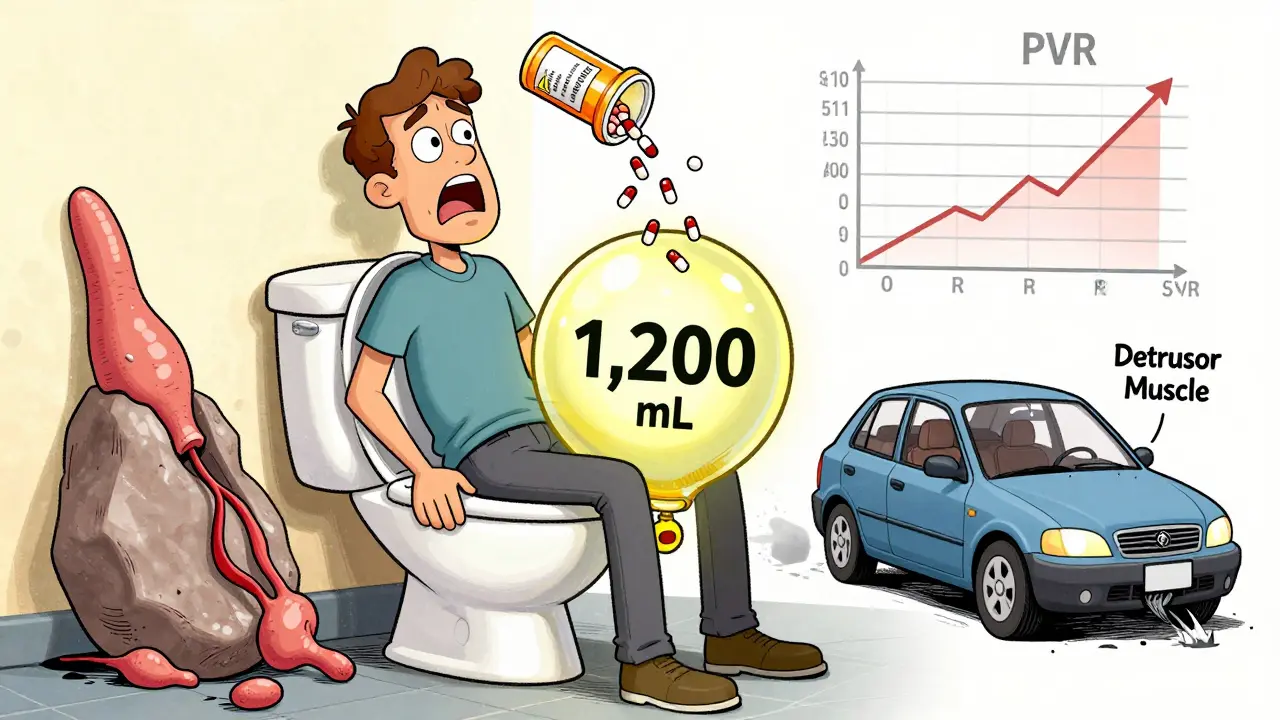
Anticholinergics block acetylcholine, a chemical that tells the bladder muscle to contract. In people with overactive bladder, this helps reduce sudden urges and leaks. But in men with BPH, the bladder is already struggling. The enlarged prostate squeezes the urethra, forcing the bladder to work harder just to push urine out. The detrusor muscle, the main bladder muscle, is already stretched thin and firing at full capacity.
Adding an anticholinergic is like turning down the engine on a car climbing a steep hill. It doesn’t just slow things down - it can stop the car completely. Studies show men with BPH who take these drugs have a 2.3-fold higher risk of acute urinary retention compared to those who don’t. This isn’t a rare side effect. Between 2018 and 2022, over 1,200 cases of urinary retention linked to anticholinergics were reported to the FDA, and 63% of those cases involved men over 65 with diagnosed prostate enlargement.
The Double Hit: Anatomy Meets Pharmacology
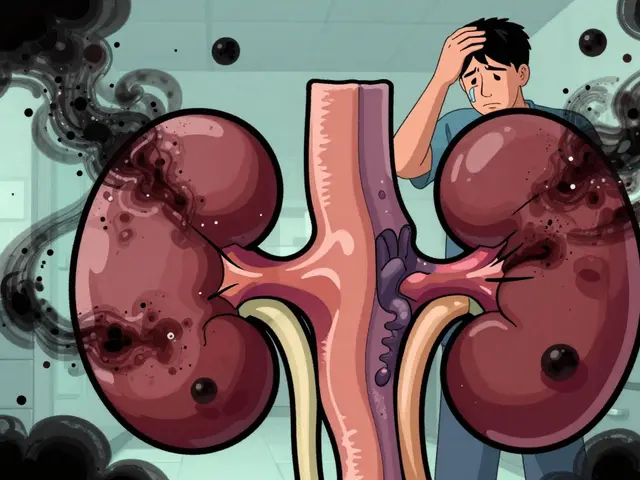
There’s a reason this risk isn’t just theoretical. BPH creates two problems: physical obstruction and bladder weakness. As the prostate grows, it narrows the urethra. The bladder responds by thickening its walls and contracting more forcefully. Over time, this strain can weaken the muscle. When anticholinergics are added, they blunt the bladder’s remaining strength. The combination - obstruction plus reduced contraction - leads to urine buildup. Post-void residual (PVR) volumes can spike to over 500 mL, sometimes more than 1,000 mL. At that point, the bladder is dangerously overdistended, and the risk of infection, kidney damage, or permanent bladder damage rises sharply.
The American Urological Association (AUA) guidelines from 2018 are clear: avoid anticholinergics in men with AUA symptom scores above 20 or prostate volumes over 30 grams. These aren’t arbitrary numbers. They’re based on data showing that men in these categories have a near 30% chance of developing retention after starting these drugs. A 2021 editorial in the Journal of Urology called anticholinergics “contraindicated” in men with moderate to severe lower urinary tract symptoms. Dr. Jerry Blaivas put it bluntly: “It’s like removing the engine from a car that’s struggling to climb a hill.”
Real Stories: When a Prescription Leads to the ER
Online patient forums are full of similar stories. On the Prostate Cancer Foundation’s community board, one user wrote: “After my doctor prescribed Detrol for urgency, I ended up in the ER with a 1,200 mL bladder. I now have a permanent catheter.” Reddit threads from r/Urology and r/ProstateHealth show that 78% of men with BPH who tried anticholinergics reported negative outcomes. Of those, 34% required emergency catheterization. These aren’t outliers. They’re predictable outcomes of a known drug-risk interaction.
Some men do manage to use these drugs safely - but only under strict conditions. One Reddit user shared: “My urologist put me on low-dose Vesicare with monthly flow tests. It helped my urgency without retention.” That’s the exception, not the rule. Studies show that even in carefully selected men with mild BPH and clear overactive bladder symptoms, retention rates still hit 12%. For most, the risk isn’t worth it.
What to Do Instead: Safer Alternatives
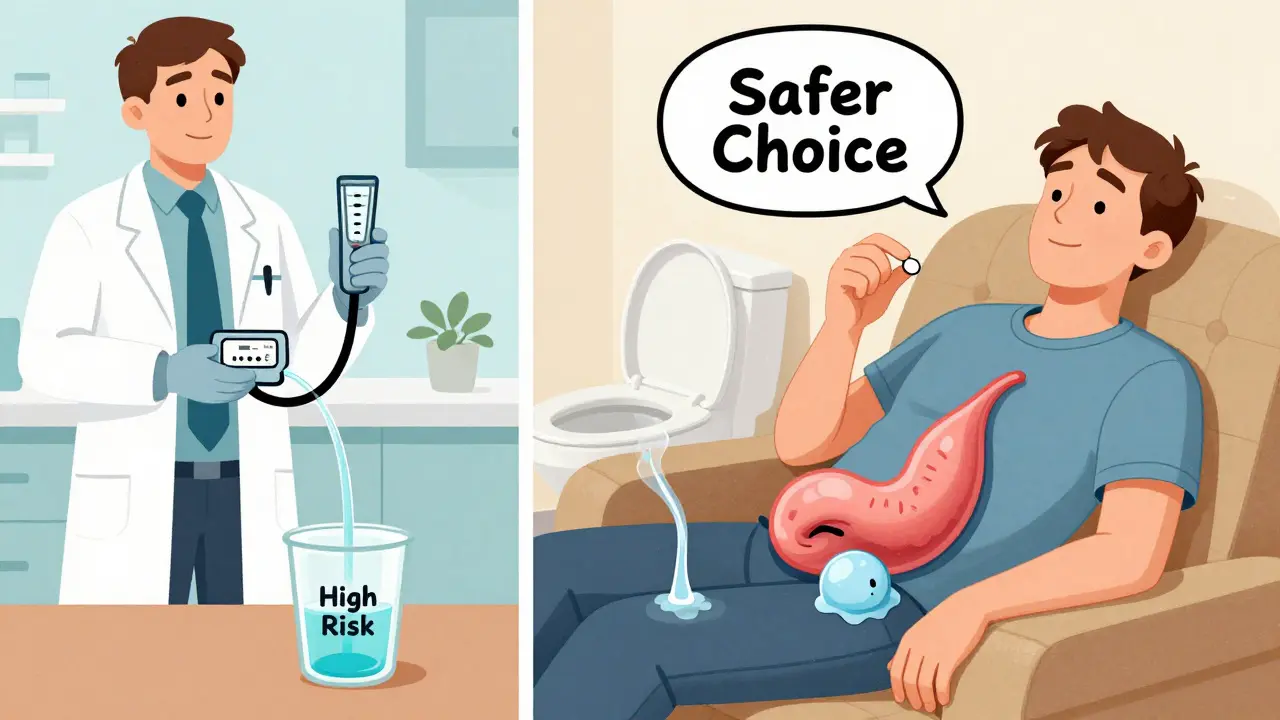
There are better options. Alpha-blockers like tamsulosin (Flomax) and alfuzosin (Uroxatral) relax the prostate and bladder neck muscles, improving urine flow. A 2008 review in American Family Physician found that men with BPH treated with alpha-blockers after catheter insertion had a 30-50% higher chance of successfully voiding within two to three days compared to those on placebo. These drugs don’t weaken the bladder - they remove the blockage.
For long-term management, 5-alpha reductase inhibitors like finasteride (Proscar) and dutasteride (Avodart) shrink the prostate over time. Studies show that taking these for four to six years cuts the risk of acute retention by half. They take months to work, but they address the root cause.
And then there’s mirabegron (Betmiga) and vibegron (Gemtesa). These are beta-3 agonists, not anticholinergics. Instead of blocking bladder contractions, they gently stimulate the detrusor muscle to relax and hold more urine. A 2022 study in European Urology found only a 4% retention rate in men with mild BPH using mirabegron - compared to 18% with anticholinergics. The FDA approved vibegron in 2020 specifically for men with BPH who can’t tolerate older bladder drugs.
Screening Before You Prescribe
If a doctor still considers anticholinergics, proper screening is non-negotiable. Three simple tests can prevent disaster:
- Digital rectal exam (DRE) - to estimate prostate size.
- Uroflowmetry - measures urine flow rate. A peak flow under 10 mL/sec signals high risk.
- Post-void residual (PVR) - checks how much urine is left after peeing. A PVR over 150 mL means the bladder is already struggling.
If any of these show signs of obstruction, anticholinergics should be off the table. Yet, the American Geriatrics Society’s 2019 Beers Criteria still lists anticholinergics as “potentially inappropriate” for older adults with BPH - and yet, 40% of nursing home residents with these conditions are still getting them.

The Future: Personalized Risk and Declining Use
Research is moving toward smarter decisions. The National Institute of Diabetes and Digestive and Kidney Diseases (NIDDK) is funding studies using prostate MRI and genetic markers to predict who might safely use anticholinergics. Early results suggest a small subset of men - those with true detrusor overactivity and minimal obstruction - might benefit. But for now, the European Association of Urology’s 2023 guidelines say it plainly: “The risk-benefit ratio is unfavorable in all but the most carefully selected patients.”
Market data confirms the shift. GlobalData predicts a 35% drop in anticholinergic prescriptions for men over 65 with BPH by 2028. Why? Better alternatives, clearer guidelines, and more awareness. The days of using these drugs as a first-line fix for prostate-related urgency are ending.
What You Should Do Now
If you’re a man with BPH and your doctor suggests an anticholinergic:
- Ask for your uroflowmetry and PVR results. If they’re abnormal, don’t take it.
- Ask about alpha-blockers or beta-3 agonists instead.
- If you’re already on one, monitor for symptoms: inability to urinate, bloating, discomfort. If you can’t pee within 12 hours, go to the ER.
- Don’t assume it’s “just part of aging.” This is a preventable medical emergency.
The goal isn’t to eliminate urgency. It’s to manage it without risking your bladder’s function - or your health.
Can anticholinergics cause urinary retention even in men without prostate problems?
Yes, but it’s rare. Anticholinergics can cause urinary retention in anyone, especially older adults or those with nerve damage, diabetes, or spinal cord injuries. However, the risk is dramatically higher in men with BPH because their bladders are already under strain. In men without prostate issues, retention is uncommon and usually only happens with very high doses or when combined with other medications like opioids or tricyclic antidepressants.
What are the signs of acute urinary retention?
The main signs are a sudden inability to urinate despite a strong urge, lower abdominal pain or swelling, and a feeling of fullness in the bladder. Some men feel nauseous or dizzy. The bladder can swell to over 1,000 mL - that’s more than a liter of urine trapped inside. This is a medical emergency. Delaying treatment can damage the bladder or kidneys.
Is it safe to take anticholinergics if I have mild BPH?
It’s not recommended. Even mild BPH increases the risk of retention. A 2017 study found a 12% retention rate in men with mild BPH taking solifenacin - still too high to justify the small benefit. The AUA and EAU guidelines advise against it. If you have urgency, try alpha-blockers or beta-3 agonists first. They’re safer and often just as effective.
How long does it take for anticholinergics to cause retention?
It can happen anytime - from the first dose to after months of use. Some men notice trouble within hours. Others develop retention gradually. There’s no safe waiting period. That’s why screening before starting the drug is critical. If you’ve been on an anticholinergic for a while and suddenly can’t urinate, don’t wait. Go to the ER.
Can I switch from an anticholinergic to a safer drug?
Yes, and you should. If you’re on oxybutynin, tolterodine, or similar drugs and have BPH, talk to your urologist about switching to tamsulosin, mirabegron, or vibegron. These alternatives don’t weaken bladder contractions. They either relax the prostate or gently help the bladder hold urine. Most men see improvement in urgency without the retention risk. Don’t stop your current drug suddenly - work with your doctor on a safe transition plan.
Anticholinergics aren’t inherently bad. For women with overactive bladder and no prostate issues, they can be life-changing. But for men with BPH, they’re a ticking time bomb. The best treatment isn’t the one that silences urgency - it’s the one that lets you pee safely.



14 Comments
Just wanted to say this post saved my dad’s bladder. He was on oxybutynin for years and didn’t even know it was making things worse. Got him switched to tamsulosin last year and he’s been peeing like a 25-year-old again. Seriously, if you’re a man over 60 and your doc pushes anticholinergics, ask for flow tests first. No shame in being proactive.
It is imperative to underscore that the pharmacological mechanism of anticholinergic agents directly antagonizes the parasympathetic innervation of the detrusor muscle. In the context of benign prostatic hyperplasia, this results in an imbalance between outlet resistance and bladder contractility, precipitating acute urinary retention. The data cited from the FDA and AUA guidelines are robust and corroborated by multiple cohort studies.
My urologist never mentioned this risk when I was prescribed Vesicare. I didn’t realize how bad it was until I couldn’t pee after dinner one night. Took me 45 minutes to finally go. That’s when I asked for a PVR test. Mine was 600 mL. He switched me to mirabegron right away. No more ER trips. Just wish I’d known sooner.
Why do doctors still prescribe this junk? It’s obvious. Pharma reps give them free lunches and pens. The real solution? Cut out the middleman. Just take saw palmetto and drink water. Everyone knows natural remedies work better anyway. This whole system is rigged. And don’t even get me started on the FDA’s corruption.
Man, this is why America’s healthcare is broken. You got some guy in India or Nigeria telling us how to treat our bodies. We’ve got the smartest doctors in the world. Why are we listening to some journal from Europe? We don’t need their guidelines. We need common sense. If you can’t pee, just push harder. That’s what my grandpa did.
Did you know the WHO is secretly funded by Big Pharma to suppress natural cures? Anticholinergics aren’t the problem - it’s the catheters they’re pushing. They want you dependent on machines so they can charge you $2,000 every time you need a new one. I’ve been on a lemon juice and apple cider vinegar regimen for 3 years now. I haven’t seen a doctor since 2019. My prostate? It’s a myth. They invented BPH to sell drugs.
I read this whole thing and just sat there thinking about how many men are out there right now sitting on the toilet for 20 minutes, sweating, terrified they’re not going to make it. It’s not just a medical issue - it’s a quiet, lonely kind of shame. I’m glad someone finally put it in plain language. My uncle had to get a catheter after being on Detrol for six months. He never talked about it. No one did. We just pretended everything was fine. This post? It’s the conversation we’ve been avoiding.
The evidence presented here is compelling and aligns with current clinical best practices. The distinction between pharmacological suppression of bladder contractility and mechanical obstruction is fundamental. The shift toward beta-3 agonists and alpha-blockers represents a paradigmatic improvement in patient-centered care. I would encourage all clinicians to review the 2023 EAU guidelines in full.
So I’ve been on oxybutynin for 4 years. I’ve never had a problem. Why is everyone acting like this is a death sentence? Maybe I’m just one of those lucky ones? Or maybe you’re all exaggerating because you don’t like taking pills? I’m not scared of my doctor. I trust him. He’s been treating me for 12 years. You guys are just panic-selling.
They’re hiding the truth. The real reason they don’t want you using anticholinergics is because catheters cost more. Hospitals make millions off emergency urology. They don’t care if you can pee. They care if you need a $15,000 procedure. This whole thing is a money scheme. And the FDA? They’re in on it. I saw a documentary once - it was deleted from YouTube. They don’t want you to know this.
It’s fascinating how the American medical system reduces complex urological physiology to a binary of ‘safe’ and ‘dangerous.’ The reality is that individual variability in CYP enzyme metabolism, bladder compliance, and urethral resistance renders blanket guidelines obsolete. A 30g prostate volume is not a universal threshold - it’s a statistical artifact. You’re not protecting patients; you’re enforcing dogma.
They’re coming for your prostate next. First they take your meds, then they take your dignity. They’ll start requiring DNA tests before you can even pee without a catheter. This is step one of the global depopulation agenda. They want old men to stop peeing so they can control the water supply. I read this on a forum in 2021 - they’ve been planning this since the 80s. The FDA knows. The WHO knows. And they’re still letting you take these drugs. Why? Because they’re testing the limits.
Low-dose mirabegron + pelvic floor PT has been a game-changer. My PVR dropped from 480 to 85 in 6 weeks. No retention. No catheter. Just a simple switch. People think it’s all about the drug - but it’s the combo. You need the med AND the rehab. Most docs skip the rehab. That’s why patients fail. It’s not the drug - it’s the lack of holistic care.
You know what’s worse than anticholinergics? Doctors who don’t even check your PVR before prescribing. I had a guy in my urology clinic last month - 72, on solifenacin for 3 years, never had a flow test. His bladder was holding 1,400 mL. He didn’t even know he was retaining. That’s not negligence - that’s malpractice. And they wonder why people lose trust in the system. We’re not talking about side effects. We’re talking about preventable organ failure. And it’s happening every day.