




Missing a single dose of a critical medication might seem like a small mistake, but for millions of people, it's a systemic problem that leads to thousands of avoidable hospital visits every year. In the U.S. alone, medication non-adherence creates a staggering $300 billion annual cost burden. The real tragedy isn't the money, though-it's the fact that treatments fail not because the drug doesn't work, but because the patient didn't take it. Whether you're managing a chronic condition or helping a loved one stay on track, finding a reliable way to monitor medication adherence is the most effective way to ensure a treatment plan actually delivers the promised results.
The Basics of Medication Logs and Lists
For many, the first line of defense is a simple paper-based system. A medication list is a master document detailing every drug you take, the dosage, the timing, and the purpose of the medication. A medication log, on the other hand, is a diary where you check off each dose as it's consumed.
While these methods are easy to start, they have a significant flaw: they rely entirely on memory and honesty. Research published in the Annals of Internal Medicine indicates that self-reported adherence logs are only about 27% accurate. This is often due to "recall bias," where a person forgets they missed a dose and marks it as taken anyway. In some cases, a 2020 University of Michigan study found that up to 42% of patients intentionally falsify their logs to please their doctors. If you use a paper log, the key to success is updating it the exact second you swallow the pill, not at the end of the day.
Comparing Tracking Methods: From Paper to Pixels
Not all tracking methods are created equal. Depending on your health needs and tech comfort, you might choose a method that prioritizes simplicity or one that prioritizes clinical accuracy. Electronic systems provide far more reliable data because they track the action of accessing the medication rather than the memory of taking it.
| Method | Typical Accuracy | Pros | Cons |
|---|---|---|---|
| Paper Logs/Lists | ~27% | Zero cost, no tech required | High error rate, easy to fake |
| Pill Counts | ~60% | Objective physical count | Doesn't track timing of doses |
| IoT Pillboxes | ~97% | Real-time alerts, provider sync | Requires power/internet |
| Video Observation (VDOT) | ~98.5% | Visual confirmation | Time-consuming, intrusive |
Stepping Up to Digital Adherence Tools
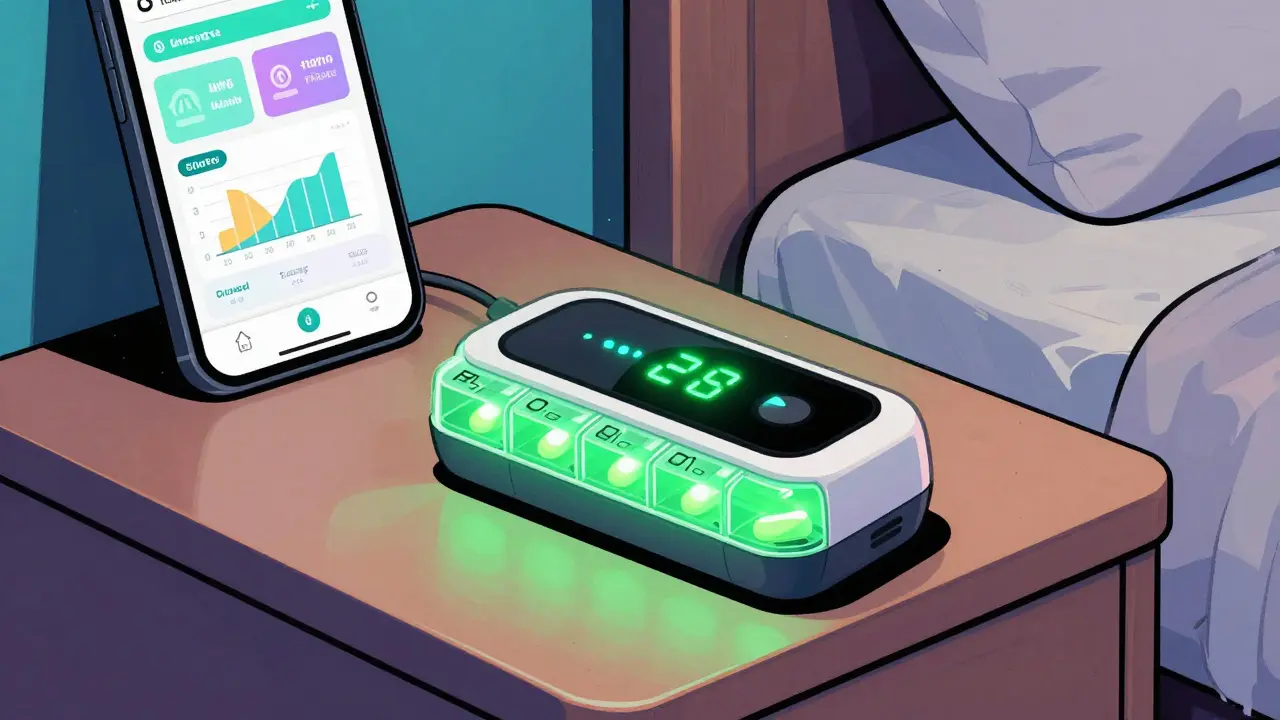
If paper isn't cutting it, IoT-enabled pillboxes is a category of smart hardware that uses cellular or Wi-Fi connectivity to track when a medication container is opened . One of the most prominent examples is the Tenovi Pillbox, which uses visual LED cues-like a red light for a pending dose and green once logged-to prompt the user. These devices remove the guesswork by sending real-time data to a provider's dashboard.
Beyond hardware, we now have Electronic Medication Management Systems (EMMS). These range from RFID-based dispensers that mechanically deliver a dose directly to the patient, to precision scales that detect the milligram-level weight change when a pill is removed from a bottle. For those who prefer software, AI-powered apps like Medisafe Predict+ are now using behavioral variables to forecast if a patient is likely to miss a dose up to 72 hours in advance, allowing pharmacists or family members to intervene before the mistake even happens.
The "Last Mile" Problem: Did the Pill Actually Get Taken?
Here is the uncomfortable truth about almost all tracking technology: most of it only tracks the opening of the bottle, not the ingestion of the drug. According to the Journal of Medical Systems, about 92% of current technologies cannot verify that the medication actually entered the patient's system. This creates a "false adherence" rate of about 12.3%, which is particularly risky for psychiatric medications where precise dosing is critical.
To solve this, some high-stakes clinical settings use Video Directly Observed Therapy (VDOT), where a clinician watches the patient take the medication via a live stream. While this is incredibly accurate, it's impractical for daily life, taking nearly 18 minutes per session. The future likely lies in biometric wearables that can detect drug efficacy through biomarkers in the bloodstream, effectively closing the loop between taking a pill and the body reacting to it.
Practical Tips for Improving Your Tracking Routine
Regardless of the tool you use, the system is only as good as the habit. To move from a haphazard list to a reliable log, try these strategies:
- Anchor the habit: Place your log or smart pillbox next to something you do every day without fail, like your coffee maker or toothbrush.
- Use redundant alerts: If using an app, set a primary alarm and a secondary "backup" alarm 30 minutes later to catch slips.
- Weekly audits: If using a paper log, spend five minutes every Sunday reviewing the past week. This helps you identify patterns-like missing doses every Tuesday-which can then be addressed with your doctor.
- Share the data: If you use a digital system, give your healthcare provider access to the dashboard. Knowing that a professional is monitoring the data often increases a patient's motivation to stay adherent.
Implementing a System in a Caregiving Role
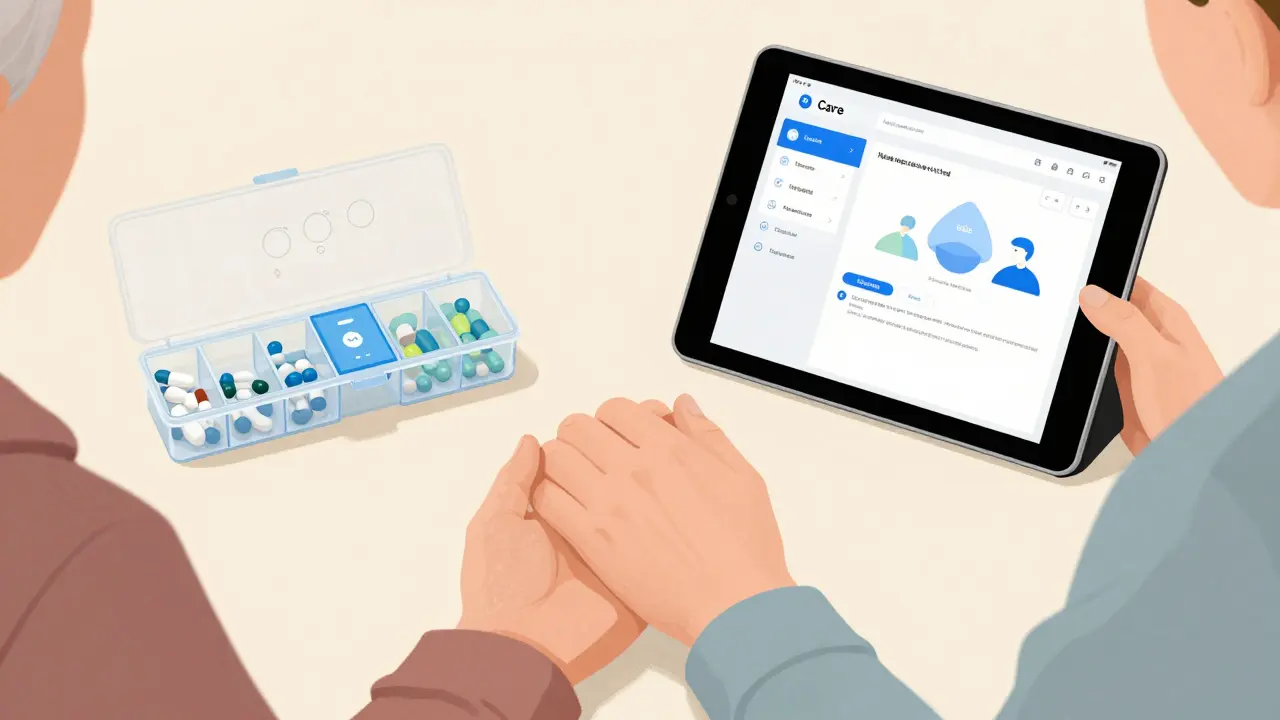
When tracking adherence for someone else, especially elderly patients, technology can be a double-edged sword. While an IoT device is more accurate, a 2022 study noted that nearly 38% of Medicare patients over 75 struggle with the literacy required for these tools. If you are a caregiver, don't just hand over a tablet and expect results.
Start with a hybrid approach. Use a physical pill organizer for the actual sorting and a digital log for your own tracking. If you transition to a system like the Cleveland Clinic's Connected Care Platform, which integrates device data with Electronic Health Records (EHR), ensure there is a clear protocol for who gets notified when a dose is missed. A notification that goes unread is the same as no notification at all.
What is the most accurate way to track if I'm taking my meds?
For most people, IoT-enabled pillboxes like the Tenovi system are the best balance of accuracy and convenience, offering about 97% accuracy. For clinical-grade certainty, Video Directly Observed Therapy (VDOT) is the gold standard at 98.5%, though it is much more time-consuming.
Why are paper medication logs considered unreliable?
Paper logs suffer from high rates of recall bias and intentional falsification. Research shows they are only about 27% accurate because patients often forget to log doses in real-time or mark them as taken to avoid conflict with their healthcare providers.
Can a smart pillbox tell if I actually swallowed the pill?
Generally, no. Most smart pillboxes and electronic monitors only track when the container is opened or the dispenser is activated. Only a small fraction of advanced systems using VDOT or future biometric wearables can verify actual ingestion.
What should I include on a master medication list?
Your list should include the generic and brand name of the drug, the exact dosage (e.g., 20mg), the frequency (e.g., twice daily), the specific time of day you take it, and the reason you are taking it. Including the prescribing doctor's name is also highly recommended for emergencies.
How does AI help with medication adherence?
AI-powered systems, such as Medisafe Predict+, analyze behavioral variables to predict non-adherence before it happens. They can forecast a missed dose with nearly 90% accuracy up to 72 hours in advance, allowing for preventative reminders.







9 Comments
I've worked with a few of these IoT systems in a clinic setting and the real-time alerts are a game changer for folks who just genuinely forget. If you're struggling, try tying the pill-taking to a specific habit like brushing your teeth; it's way more effective than just relying on a phone alarm that you can easily swipe away and ignore.
Too much reading.
The fascination with digital surveillance as a panacea for human fallibility is quite quaint. We are essentially admitting that the modern individual lacks the basic discipline required to maintain a biological baseline without a silicon babysitter. One must wonder if the systemic problem is actually the lack of adherence, or rather, a systemic erosion of personal responsibility and cognitive autonomy in the face of convenient automation.
Exactly. Why are we acting like a piece of plastic with a light on it solves a deep-seated psychological failure to follow instructions? It's just more garbage for the landfill once the battery dies.
I totally see where you're coming from regarding the loss of autonomy, but I think we should try to look at this through a lens of compassion because some people are dealing with cognitive decline or extreme stress that makes these tools a true lifeline for them. It's really about finding the right balance that fits each person's unique life journey and making sure that we are supporting our loved ones in whatever way helps them stay healthy and happy in the long run, even if that means a bit of tech intervention!
Only in America would we need a 98% accurate video stream to make sure people take their meds 🙄 The level of inefficiency is just peak! If you can't handle a simple pill bottle, you're just dead weight in this economy 💅✨
Everyone should keep pushing forward and embrace these new AI tools because the potential to save lives is absolutely massive and we should be celebrating the fact that we can now predict a mistake before it even happens! Just imagine the millions of people who will get a second chance at health because a smart app sent a notification to their family member and it is simply exhilarating to see science bridging the gap between pharmacy and daily behavior so effectively!
It is absolutely imperative that patients cease this disgraceful habit of falsifying their records to appease their physicians. Such dishonesty is not merely a lapse in judgment but a direct assault on the clinical process that jeopardizes the entire healthcare infrastructure. One must adhere to the regimen with absolute precision or accept the consequences of their own negligence without complaint!
The "last mile" problem mentioned here is the most interesting part. It's a metaphor for the gap between action and effect. We can track the hand moving to the bottle, but the actual chemical transition remains a hidden event. It makes me think about how much of our lives we track via proxies rather than actual experience.