

Why Hyperkalemia Is a Silent Threat in Chronic Kidney Disease
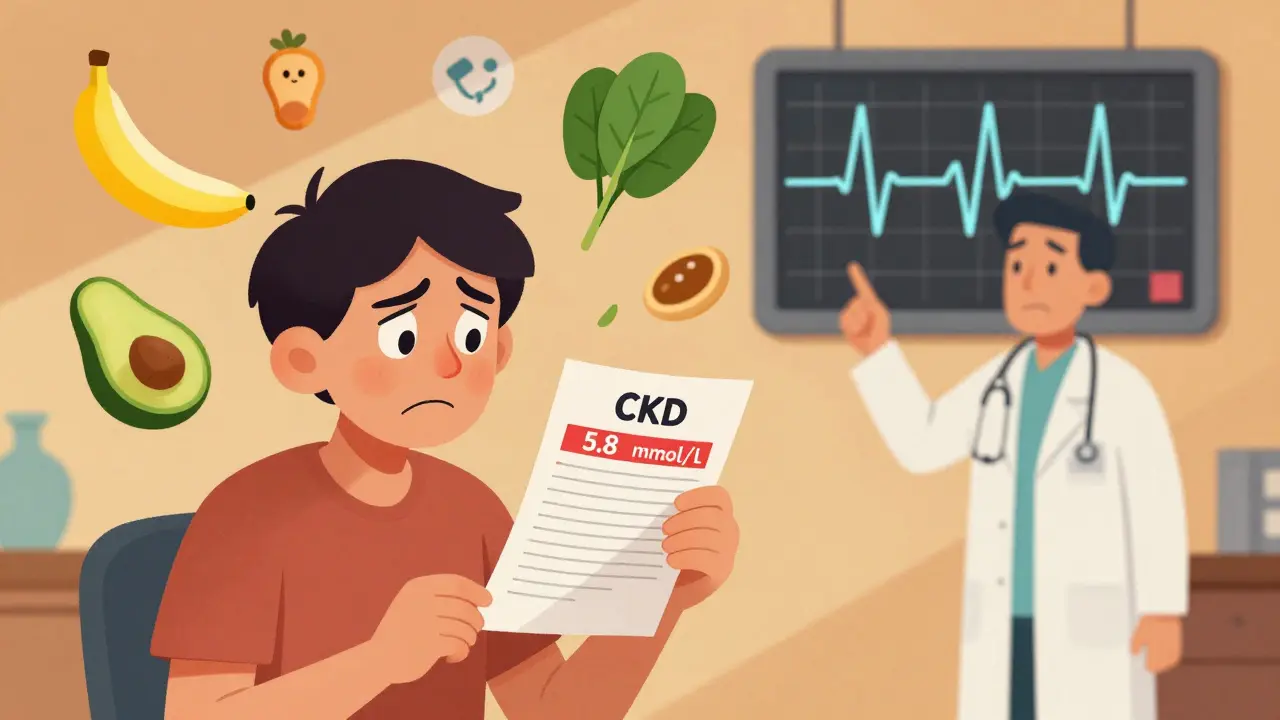
When your kidneys aren’t working well, potassium builds up in your blood. That’s hyperkalemia - and it’s not just a lab number. At levels above 5.0 mmol/L, it can stop your heart. In people with advanced chronic kidney disease (CKD), nearly half will experience it at some point. The real danger? Many don’t feel symptoms until it’s too late. Muscle weakness, fluttering in the chest, or an irregular heartbeat might be the only signs - and by then, emergency care is already needed.
Here’s the catch: the very drugs that protect your heart and kidneys - like ACE inhibitors and ARBs - make hyperkalemia more likely. These medications are essential for slowing kidney damage and reducing heart attacks, but they also reduce how much potassium your body can flush out. For years, doctors had to choose between protecting your heart and keeping your potassium safe. Now, we have better tools.
What Your Potassium Level Really Means
Normal potassium is between 3.5 and 5.0 mmol/L. In CKD, experts now aim for 4.0 to 4.5 mmol/L - not just to avoid danger, but to maximize the benefits of heart-protecting drugs. Levels above 5.5 mmol/L are considered dangerous. At 6.0 mmol/L or higher, your ECG will start showing changes: tall, pointed T-waves, then widened QRS complexes. That’s your body screaming for help.
Most people with CKD don’t know their potassium is climbing until a routine blood test or an emergency visit. That’s why regular monitoring is non-negotiable. If you’re on RAAS inhibitors, your doctor should check your potassium within 1-2 weeks after starting or increasing the dose. After that, every 3-6 months if you’re stable. But if you feel weak, dizzy, or notice your heart skipping beats - get tested right away.
Dietary Limits: What You Can and Can’t Eat
Not all potassium is bad. Your body needs it to work. But in CKD, your kidneys can’t keep up. The amount you can safely eat depends on how far your kidney disease has progressed.
- Stages 1-3a (mild to moderate CKD): No need to cut back drastically. Focus on avoiding excessive amounts - like eating five bananas a day. A balanced diet with controlled portions is enough.
- Stages 3b-5 (advanced CKD, not on dialysis): You need to limit potassium to 2,000-3,000 mg per day. That’s about 51-77 mmol. Sounds simple? It’s not.
High-potassium foods to watch out for:
- Bananas (422 mg per 100g)
- Oranges and orange juice (181 mg per 100g)
- Potatoes (421 mg per 100g)
- Spinach, tomatoes, avocados, beans, and dried fruit
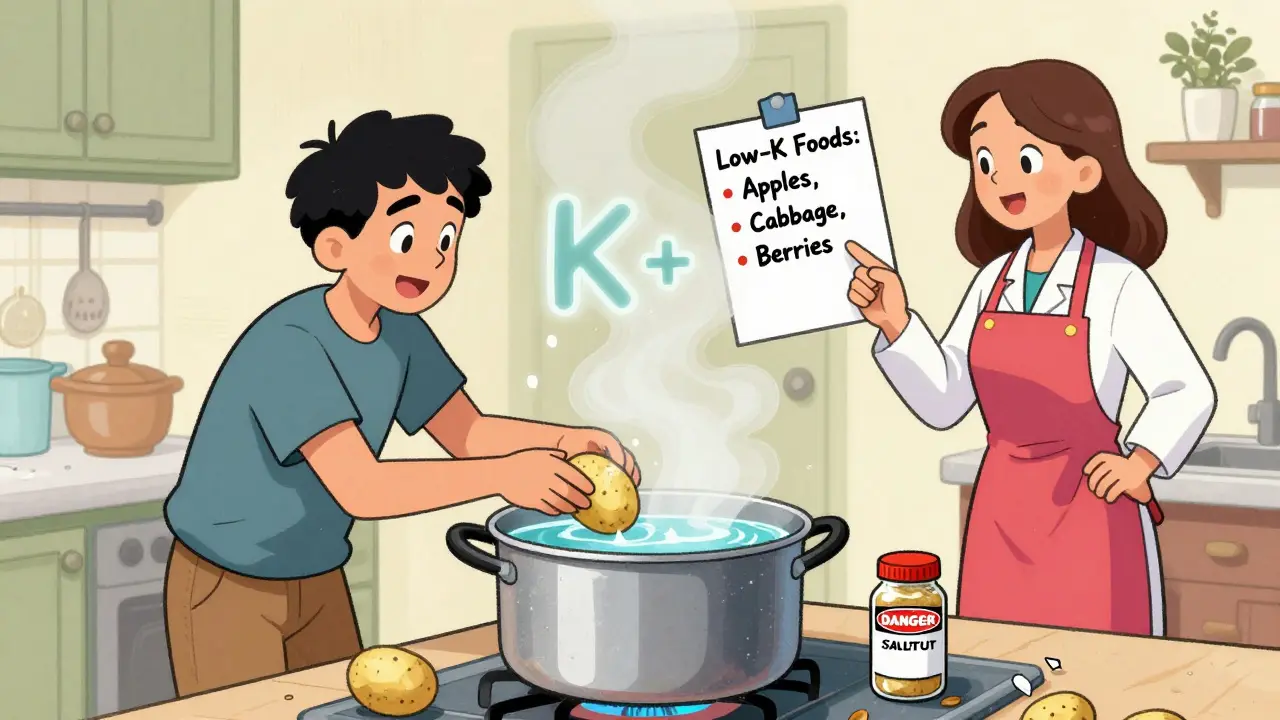
Here’s what works: leaching. Boiling potatoes, carrots, or beets in plenty of water, then discarding the water, can cut potassium by up to 50%. Rinse canned foods before eating. Avoid salt substitutes - many contain potassium chloride. And don’t drink vegetable juices or sports drinks unless your dietitian says it’s safe.
Many patients struggle with this. One study found only 37% of CKD patients consistently follow low-potassium diets. Social events, family meals, and cravings make it hard. But the cost of ignoring it? Higher risk of heart rhythm problems, hospital visits, and even death.
Emergency Treatment: What Happens When Potassium Spikes
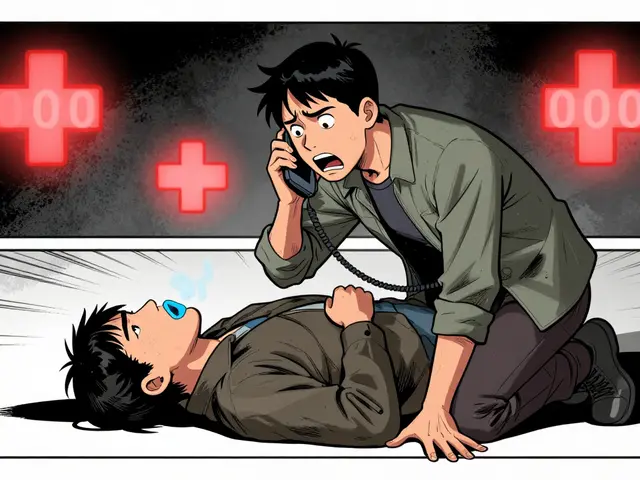
If your potassium hits 5.5 mmol/L or higher - especially with ECG changes - you need immediate action. This isn’t something to wait on. Emergency treatment has three key steps:
- Calcium gluconate (10 mL of 10% solution IV): Given over 2-5 minutes. It doesn’t lower potassium, but it protects your heart muscle from the dangerous effects. Works in 1-3 minutes. Lasts 30-60 minutes.
- Insulin and glucose (10 units insulin + 50 mL of 50% dextrose): This drives potassium into your cells. Starts working in 15-30 minutes, lowers levels by 0.5-1.5 mmol/L. But it can cause low blood sugar - so glucose is always given with it.
- Sodium bicarbonate (50-100 mmol IV): Only if you’re also acidotic (bicarbonate below 22 mmol/L). Works in 5-10 minutes. Not for everyone, but helpful when acidosis is present.
These are temporary fixes. They buy time - but they don’t remove potassium from your body. That’s where dialysis or binders come in.
Chronic Management: New Drugs That Changed Everything
For years, the only option for long-term potassium control was sodium polystyrene sulfonate (SPS), a powder you swallow. It had major problems: it could cause deadly colon damage, raised sodium levels, and needed to be taken three times a day. Many patients stopped using it.
Now, we have two game-changers:
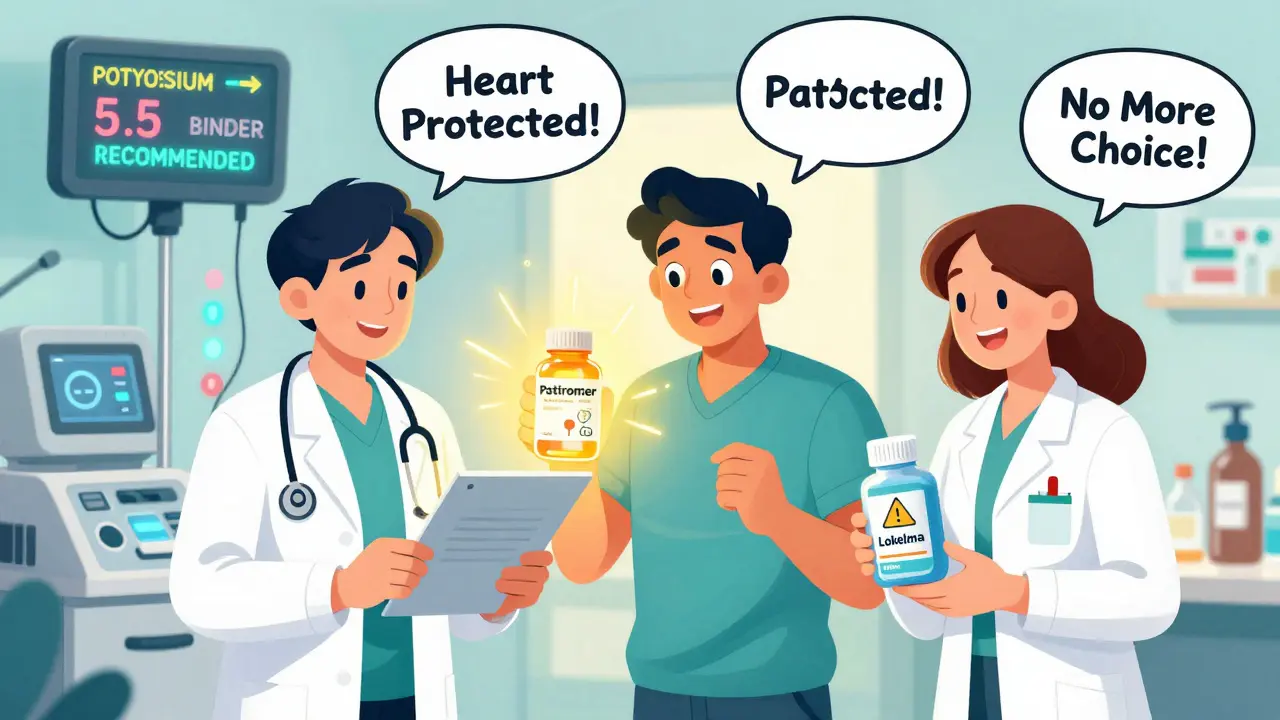
- Patiromer (Veltassa): Taken once daily. It binds potassium in the gut and removes it in stool. Doesn’t raise sodium. Side effects? Constipation (14%) and low magnesium (19%). It’s slow - takes 4-8 hours to start working. Best for stable, long-term control.
- Sodium zirconium cyclosilicate (Lokelma): Works faster - starts lowering potassium in under an hour. Great for sudden spikes. But it adds sodium: about 1.2 grams per day. That can worsen swelling in people with heart failure. Taken twice daily. Better for acute flare-ups.
Here’s what matters: you can stay on your heart and kidney medications. Before these drugs, nearly half of patients had to lower or stop RAAS inhibitors because of high potassium. Now, 78% of patients on patiromer can stay on full doses. With SZC, 83% can keep their mineralocorticoid blockers. That’s huge. Stopping these drugs increases your risk of heart attack and kidney failure by up to 34%.
Who Manages This? A Team Approach
You can’t do this alone. Managing hyperkalemia in CKD needs a team:
- Nephrologist: Decides when to adjust meds, when to start binders, and how to balance risks.
- Renal Dietitian: Teaches you how to eat safely. They’ll give you a personalized plan, show you how to leach vegetables, and help you track intake. Most require 40+ hours of specialized training.
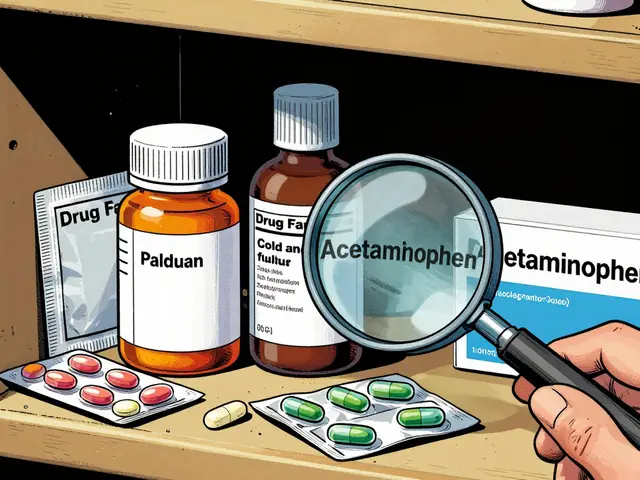
- Clinical Pharmacist: Checks for drug interactions. Patiromer can reduce absorption of levothyroxine by 23% if taken too close together. Timing matters - take other meds at least 6 hours apart.
Successful programs use electronic alerts. If your potassium hits 5.0 mmol/L, your chart triggers a referral to a dietitian and pharmacist within 72 hours. That’s how you prevent emergencies.
The Cost and Access Problem
These new drugs work - but they’re expensive. Patiromer costs about $635 a month in the U.S. SPS? Around $47. That’s a 13-fold difference. In the UK, SPS is £47 a month; patiromer is £286. Many patients can’t afford the newer options. Community clinics lag behind academic centers - only 48% of community nephrologists use newer binders, compared to 82% in teaching hospitals.
Insurance coverage varies. Some require trying SPS first. Others won’t cover binders unless potassium is above 5.5 mmol/L for 30 days. That’s too late for many. The good news? Studies show these drugs save money long-term. One hospitalization for hyperkalemia costs $12,450. A binder might pay for itself in under two years.
What’s Next? The Future of Potassium Control
Research is moving fast. New drugs like tenapanor - originally for phosphate control - are showing promise in lowering potassium without systemic absorption. Digital tools are helping too. Apps that scan food barcodes and calculate potassium content are improving diet adherence by 32% in early trials.
Guidelines are changing. The European Renal Association is proposing lowering the intervention threshold to 5.3 mmol/L for advanced CKD patients. Why? Because even small rises above 5.0 mmol/L increase death risk by 18% per 0.5 mmol/L jump.
By 2027, experts predict 75% of CKD patients on heart-protecting drugs will also be on a potassium binder. That’s not science fiction - it’s becoming standard care.
What You Should Do Today
- Know your latest potassium level. If you don’t know it, call your doctor.
- Ask if you’re on a RAAS inhibitor. If yes, ask if your potassium is being monitored regularly.
- If your potassium is high, ask about binders - not just diet. You don’t have to choose between your heart and your kidneys anymore.
- See a renal dietitian. Don’t guess what foods are safe. Get a personalized plan.
- Track your symptoms. Weakness? Palpitations? Don’t wait. Get checked.
Hyperkalemia isn’t inevitable in CKD. With the right tools - diet, monitoring, and modern meds - you can live well, stay protected, and avoid the ER.
Can I still eat fruits and vegetables with CKD and high potassium?
Yes - but you need to choose wisely and prepare them properly. Avoid high-potassium fruits like bananas, oranges, and dried fruit. Instead, opt for apples, berries, grapes, and cabbage. For vegetables like potatoes and carrots, peel them, cut them small, and boil them in plenty of water - then discard the water. This can reduce potassium by up to half. Portion control matters: one small serving is safer than a large bowl.
Do I need to stop my blood pressure meds if my potassium is high?
No - and you shouldn’t. Stopping or lowering RAAS inhibitors (like lisinopril or losartan) increases your risk of heart attack, stroke, and faster kidney decline. Instead, use potassium binders like patiromer or sodium zirconium cyclosilicate to keep potassium in range while staying on full doses. Studies show 80% of patients can stay on their meds with proper binder use.
How often should I get my potassium checked?
If you’re on RAAS inhibitors or have advanced CKD, check every 1-2 weeks after starting or changing a dose. Once stable, every 3-6 months is standard. But if you feel weak, dizzy, or notice heart palpitations, get tested immediately - don’t wait for your next appointment. Symptoms often appear only after potassium is dangerously high.
What’s the difference between patiromer and Lokelma?
Patiromer (Veltassa) works slowly - 4 to 8 hours - and is best for long-term control. It doesn’t raise sodium, making it safer for heart failure patients. Lokelma (sodium zirconium cyclosilicate) works faster - within an hour - and is better for sudden spikes. But it adds sodium, which can worsen swelling. Patiromer is once daily; Lokelma is twice daily. Your doctor will pick based on your needs: speed vs. sodium risk.
Are there natural ways to lower potassium without drugs?
Diet and preparation are key, but they’re not enough on their own in advanced CKD. Leaching vegetables, avoiding salt substitutes, and limiting high-potassium foods help. But if your kidneys are severely damaged, you’ll likely still need a binder. No herb, tea, or supplement reliably lowers potassium in CKD - and some, like licorice or potassium supplements, can make it worse. Always talk to your doctor before trying anything new.
Can dialysis fix high potassium?
Yes - dialysis is very effective at removing potassium and is used in emergencies when drugs aren’t enough or potassium is above 6.5 mmol/L. But if you’re not on dialysis yet, you can still manage high potassium with diet and binders. Many patients avoid dialysis longer by using modern potassium control strategies. Dialysis isn’t the only solution - it’s one tool among many.
Why do some doctors still use SPS instead of newer binders?
Cost and access. SPS is cheap - under $50 a month - while newer binders cost over $600. Insurance rules sometimes require trying SPS first. But SPS carries risks: colon damage in up to 1% of users and sodium overload. Most experts now recommend newer binders as first-line for chronic use. If your doctor is still using SPS, ask why - and if a safer option is available.



9 Comments
I’ve been managing CKD for 5 years and honestly, the leaching trick saved my diet. Boiling potatoes in a huge pot of water and tossing the liquid? Game changer. I still eat them, just not raw or roasted. No more panic when my potassium creeps up.
Also, never thought I’d say this, but I’m kinda grateful my insurance makes me try SPS first. It’s gross, but it worked long enough for me to get on patiromer. Now I don’t feel like I’m on a prison diet.
So let me get this straight… Big Pharma invented a $600/month pill so you can keep taking your expensive blood pressure meds that KILLED your kidneys in the first place? 😏
They don’t want you to eat less salt or get off processed food. They want you to buy Veltassa. And don’t even get me started on how ‘natural’ remedies are ‘dangerous’ - but a synthetic zirconium compound is ‘safe’? LOL. Wake up people.
In India, we have been managing potassium for generations without these fancy pills. My grandmother boiled spinach three times, used less salt, ate jowar roti instead of wheat, and drank barley water. No one needed a nephrologist or a dietitian. Now everyone is dependent on Western medicine and expensive drugs. This is cultural imperialism disguised as science. We have traditional knowledge - why are we abandoning it for corporate solutions?
Hey everyone, I’m a nurse in Delhi and I’ve seen so many patients panic about potassium. Just remember - you’re not alone 💪
Leaching works. Eating smaller portions of veggies helps. And yes, you CAN stay on your heart meds with binders - I’ve had patients go from 6.2 to 4.8 in 2 weeks with Lokelma. It’s not magic, it’s medicine. Talk to your dietitian. Don’t Google everything. You got this! 🙌
Wait, so you’re telling me I can’t have my avocado toast anymore? 😭
And I’m supposed to believe that boiling potatoes reduces potassium but drinking ‘vegetable juice’ is deadly? That’s inconsistent. Also, why does everyone act like SPS is some ancient torture device? My cousin took it for 8 years and never had colon damage. Maybe it’s not the drug, it’s the dose? Or maybe people just don’t drink enough water? 🤔
Also - who made the rule that potassium has to be below 4.5? Who died and made you king of my bloodwork?
LOL at the ‘team approach’. Nephrologist? Dietitian? Pharmacist? 😂
My GP prescribed lisinopril, told me to ‘watch my bananas’, and sent me on my way. No alerts. No referrals. No one checking my potassium for 11 months. I ended up in the ER with a 6.8 and a heart that looked like a spike strip. Now I’m on Lokelma and my doc says ‘good job’ - but he still doesn’t know what patiromer is. This system is broken. 🤦♂️
I just want to say thank you to the person who wrote this. I’ve been terrified of my potassium levels for years, and this made me feel like there’s real hope. I’m 68, on dialysis 3x a week, and I still eat boiled carrots and apples. I don’t need to be perfect - just mindful.
And to the folks arguing about SPS vs binders - maybe we’re all just trying to survive. No one’s trying to sell you a pill. We’re trying to live long enough to see our grandkids graduate. That’s all.
Diet doesn’t work. Period. I ate ‘low potassium’ for a year. My number went from 5.1 to 5.9. Then I started patiromer. Down to 4.3 in 2 days. No magic. No leaching. Just science. Stop blaming food. Your kidneys are broken. Use the tools.
Just a quick note: if you’re on patiromer, take your thyroid med at least 6 hours apart. I learned this the hard way - my TSH went from 2.1 to 8.7 in 3 weeks. My pharmacist caught it. Don’t be like me.