

When a pharmacist hands you a generic pill instead of your usual brand-name drug, you might wonder: is this really the same thing? The answer lies in the FDA Orange Book - a quiet but powerful tool that decides whether a generic drug can legally replace a brand-name one. It’s not marketing. It’s science. And if you’re a patient, caregiver, or healthcare professional, knowing how to check it can save you time, money, and uncertainty.
What Is the FDA Orange Book?
The FDA Orange Book, officially titled Approved Drug Products with Therapeutic Equivalence Evaluations, is the U.S. Food and Drug Administration’s official list of prescription drugs approved for sale in the United States. It doesn’t just list names - it tells you which generics are safe to swap for brand-name drugs. This system was created under the Hatch-Waxman Act of 1984 to balance innovation with affordability. Since then, over 14,000 generic drugs have been approved using this framework.The Orange Book is updated daily. It covers more than 16,000 approved drug products, including both brand-name and generic versions. But here’s the key: only prescription drugs are rated for therapeutic equivalence. Over-the-counter (OTC) medicines like ibuprofen or antacids are listed but not evaluated for substitution. If you’re checking for an OTC product, the Orange Book won’t give you a yes-or-no answer - and that’s by design.
Therapeutic Equivalence: What the Letters Mean
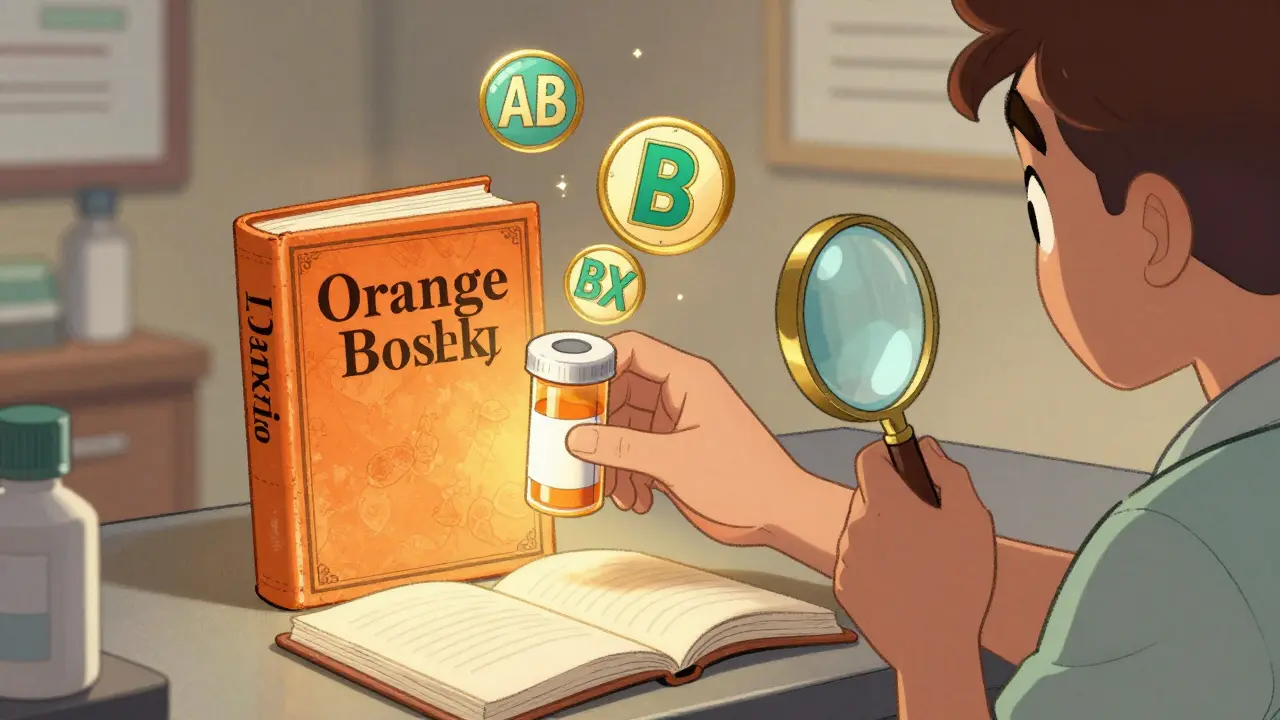
The real magic of the Orange Book is in its two-letter codes - called Therapeutic Equivalence (TE) codes. These aren’t random labels. They’re the FDA’s official judgment on whether a generic drug can be substituted without changing how the medicine works in your body.Here’s what you need to know:
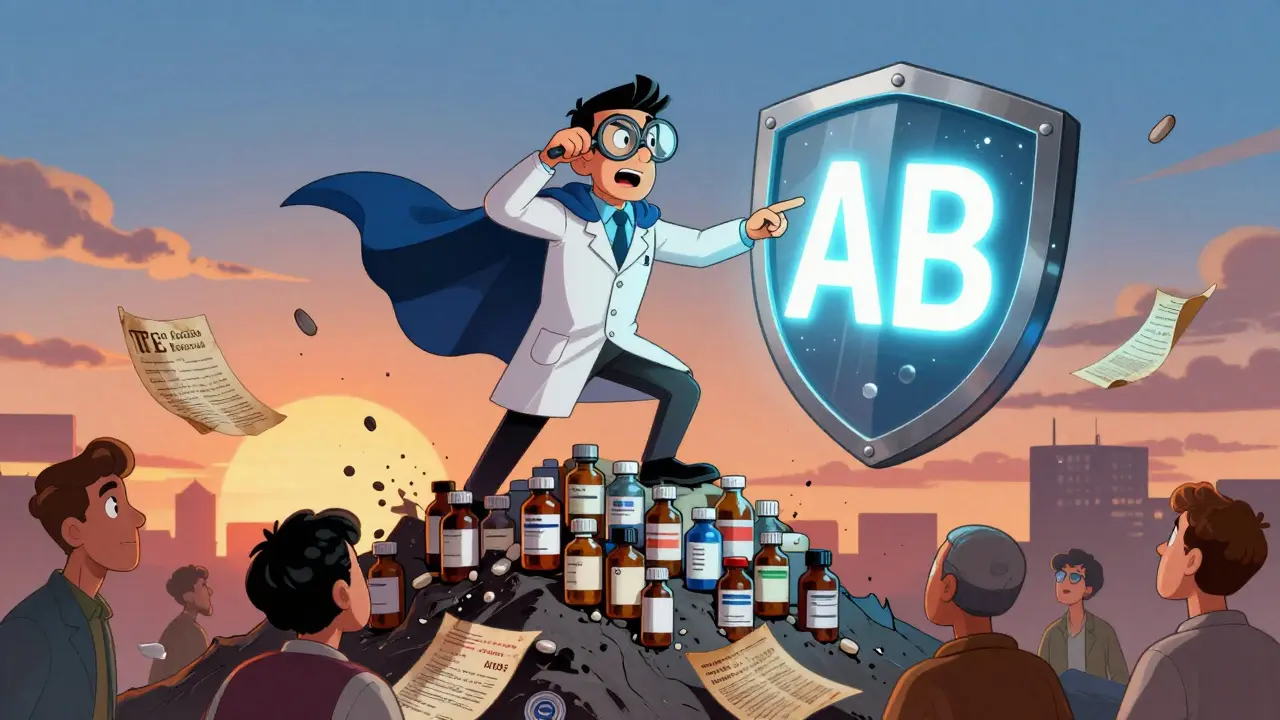
- AB - This is the gold standard. It means the generic has been proven to be pharmaceutically and bioequivalent to the brand-name drug. You can safely swap it. Most generics you see in your prescription are AB-rated.
- AB1, AB2, AB3 - These are subcategories. When multiple brand-name drugs (called Reference Listed Drugs or RLDs) exist for the same active ingredient, each gets its own number. A generic marked AB1 is equivalent only to the first RLD, not the second or third. Mixing them up can lead to errors.
- B - This means the FDA has concerns. The generic might have different absorption, stability, or delivery issues. It’s not considered interchangeable. Don’t substitute.
- BX - Rare, but important. These are products where bioequivalence hasn’t been fully established. They’re often older drugs with complex formulations like inhalers, topical creams, or extended-release tablets.
These codes are assigned automatically when the FDA approves a generic drug. The manufacturer doesn’t apply for them. The FDA evaluates the data - bioavailability studies, dissolution tests, manufacturing standards - and assigns the code. If a drug doesn’t have a TE code at all, it’s either discontinued or an OTC product.
How to Search the Electronic Orange Book
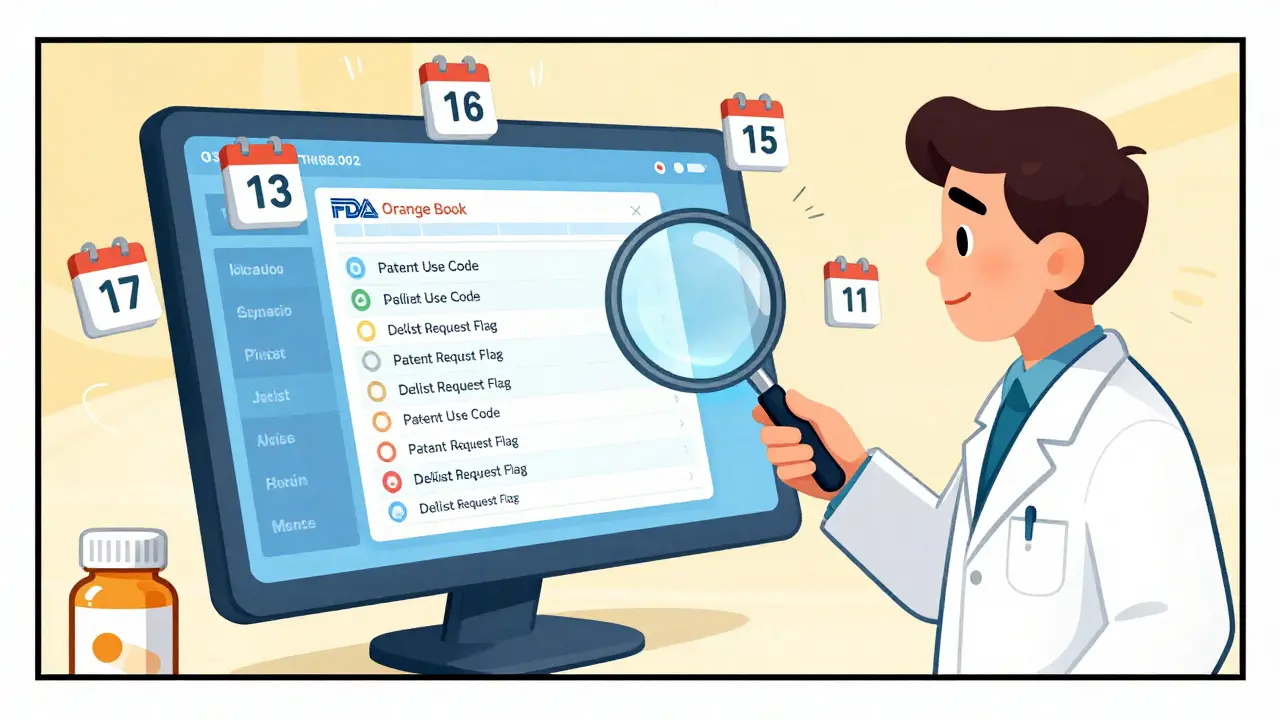
The official version is online: the Electronic Orange Book. It’s free, updated daily, and designed for real-world use. Here’s how to use it step by step:- Start with the brand name. Type in the brand you’re trying to replace - say, Synthroid. Don’t search for the generic name yet. The brand is your anchor.
- Find the active ingredient. The results will show you the active ingredient - in this case, levothyroxine sodium. Write it down.
- Do an Ingredient Search. Go back to the main search page and choose “Ingredient Search.” Enter the active ingredient you just found. Click Search.
- Filter by dosage form and route. You’ll see dozens of products. Narrow it down by selecting the exact form: tablet, capsule, solution, etc. - and the route: oral, topical, inhalation. This is critical. A tablet and a capsule of the same drug aren’t always interchangeable.
- Look for the RLD column. One product will say “Yes” under Reference Listed Drug (RLD). That’s the original brand or the FDA’s chosen standard. All others are generics.
- Check the TE Code column. Every generic in that group will have a code. If it says AB, AB1, or AB2 - it’s approved for substitution. If it’s blank or says B or BX - don’t substitute without consulting your provider.
Pro tip: Use the “Application Number” column to trace back to the original drug application. If you’re unsure, copy the number and look it up on the FDA’s Drugs@FDA site for full review documents.
What the Orange Book Doesn’t Tell You
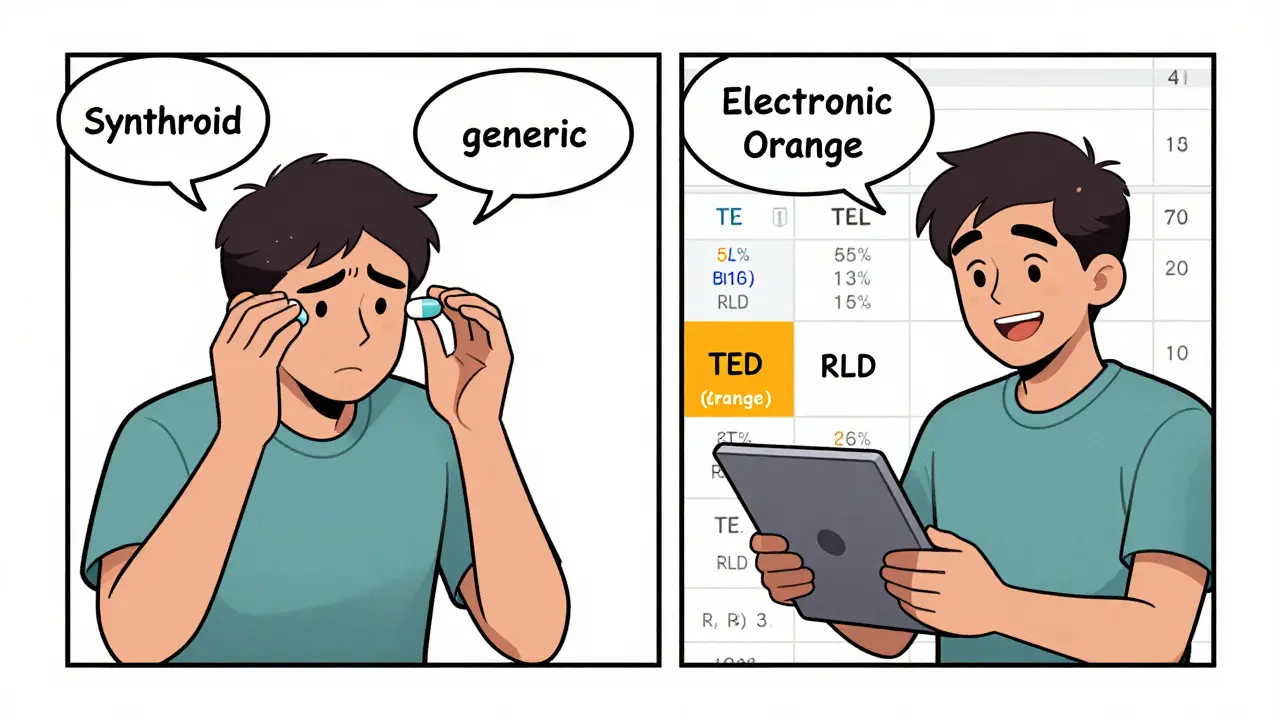
The Orange Book is authoritative - but it’s not the whole story. It tells you if a drug is therapeutically equivalent. It doesn’t tell you if your state allows substitution, or if your insurance requires prior authorization.For example: Levothyroxine (Synthroid) is AB-rated. But in many states, pharmacists can’t switch you from Synthroid to a generic without a doctor’s note. Why? Because levothyroxine has a narrow therapeutic index - tiny changes in dose can cause big effects. The FDA says it’s equivalent. Your state law says: proceed with caution.
Another blind spot: complex drug forms. Inhalers, transdermal patches, and injectables often have AB ratings - but the bioequivalence data may be based on lab tests, not real-world patient outcomes. Pharmacists report that some patients report different side effects or effectiveness with generics in these categories, even when the TE code says AB.
Also, patent listings in the Orange Book can delay generic entry. Some brand companies list dozens of patents - even minor ones - to extend market exclusivity. The FDA doesn’t judge the validity of these patents. It just lists them. So a drug might be AB-rated but still not available as a generic because of legal battles.
Real-World Tips from Pharmacists
A 2022 survey of over 1,200 U.S. pharmacists found that 68% consult the Orange Book weekly. But 42% said they still struggle with complex cases - especially with topical creams, inhalers, and multi-dose generics.Here’s what experienced pharmacists do:
- Always check the TE code, not just the name. Two drugs may have the same active ingredient and dose, but different TE codes if they’re linked to different RLDs.
- Use the FDA’s Quick Reference Guide. It’s a free 12-page PDF that walks you through common searches. Save it.
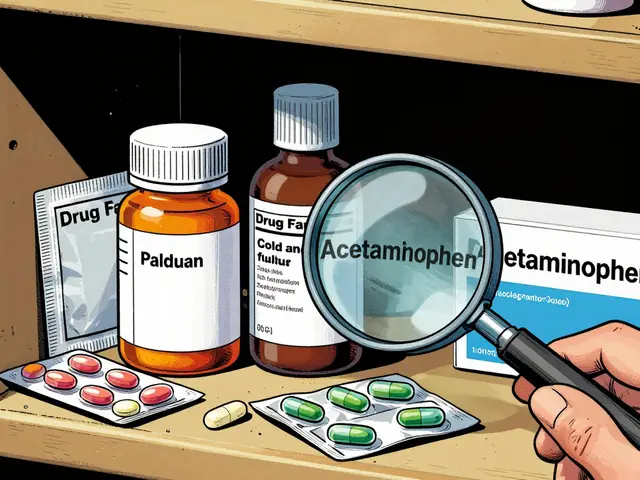
- Don’t trust third-party apps blindly. Sites like Drugs.com or IBM Micromedex pull data from the Orange Book - but they’re often 24 to 72 hours behind. For critical decisions, go straight to the source.
- When in doubt, contact the FDA. Their email support ([email protected]) responds to 95% of questions within two business days. No need to guess.
One pharmacist in Ohio shared a story: A patient asked why her generic levothyroxine made her feel jittery. She checked the Orange Book. The generic was AB1-rated - meaning it matched the first RLD, but her original prescription was based on a different RLD (AB2). She switched back - and her symptoms disappeared. The drugs were chemically identical. But the formulation differences, though small, mattered to her body.
Why This Matters
Generic drugs make up 90% of prescriptions filled in the U.S. - but only 23% of total drug spending. That’s billions saved every year. The Orange Book is the engine behind that savings. It lets pharmacies, insurers, and patients make confident substitutions without compromising safety.But it only works if you know how to use it. A misread TE code can lead to ineffective treatment. A missed RLD distinction can mean a patient gets a different formulation than what their doctor intended.
The FDA doesn’t expect you to be an expert. But it does expect you to check. Five minutes with the Electronic Orange Book can prevent a week of side effects, a denied insurance claim, or a return visit to the doctor.
Next time you’re handed a generic, don’t just take it. Look it up. Find the TE code. Confirm the RLD. Know what you’re taking - and why.
What does an AB rating mean in the FDA Orange Book?
An AB rating means the generic drug has been proven by the FDA to be therapeutically equivalent to the brand-name reference drug. It has the same active ingredient, dosage form, strength, and route of administration, and has passed bioequivalence testing. This means it can be safely substituted at the pharmacy level without changing how the drug works in your body.
Can I substitute any generic with an AB rating for my brand-name drug?
Legally, yes - but practically, sometimes no. While the FDA says AB-rated generics are interchangeable, individual states can impose additional rules. For drugs with a narrow therapeutic index - like levothyroxine, warfarin, or lithium - many states require a doctor’s approval before substitution. Always check your state’s pharmacy laws and consult your provider if you’re unsure.
Why are some generic drugs not rated in the Orange Book?
There are two main reasons. First, the drug might be over-the-counter (OTC) - the FDA does not evaluate OTC products for therapeutic equivalence. Second, the drug might be discontinued and no longer available on the market. These appear in a separate Discontinued Drug Product List and won’t have a TE code. If you don’t see a code, it’s not an approved interchangeable generic.
What’s the difference between AB1, AB2, and AB3 ratings?
These numbers indicate which specific brand-name drug (called a Reference Listed Drug or RLD) the generic is equivalent to. When multiple brand drugs exist for the same active ingredient, each gets its own RLD number. A generic rated AB1 matches only the first RLD, AB2 matches the second, and so on. Substituting an AB1 generic for a drug originally prescribed as AB2 could lead to unintended differences in formulation - even if the active ingredient is the same.
Is the Electronic Orange Book the most reliable source?
Yes. The Electronic Orange Book is the official, real-time database maintained by the FDA. Third-party sites like Drugs.com or Micromedex pull data from it but can be delayed by 24 to 72 hours. For critical decisions - especially when switching medications - always verify directly on the FDA’s website to ensure you’re working with the most current information.
How often is the Orange Book updated?
The Electronic Orange Book is updated daily with new approvals, patent changes, and TE code updates. Major revisions, like changes to the drug listing format or new guidance, are published monthly. Always check the “Last Updated” date on the site to confirm you’re viewing the latest version.
Can I use the Orange Book to check if a drug is approved for my condition?
No. The Orange Book only confirms whether a drug is approved and therapeutically equivalent to a reference product. It doesn’t list approved uses or indications. For that, you need to check the drug’s official prescribing information on Drugs@FDA or the manufacturer’s label. The Orange Book tells you if a generic can be swapped - not whether it’s right for your specific condition.
Next Steps
If you’re a patient: Keep a list of your medications and their TE codes. When a generic is offered, ask your pharmacist to show you the Orange Book code. If it’s AB, you’re good to go - unless your state says otherwise.If you’re a provider: Add a quick Orange Book check to your prescribing workflow. For high-risk drugs like thyroid meds, anticoagulants, or epilepsy drugs, note the RLD and TE code on the prescription to avoid unintended switches.
If you’re a pharmacist: Bookmark the Electronic Orange Book. Use the FDA’s free Quick Reference Guide. And when you’re unsure - email [email protected]. They’ll help.
The system works. But only if you use it right.


13 Comments
so like... i just googled 'synthroid generic' and bought the cheapest one. turns out my thyroid is now doing the cha-cha. thanks, orange book, for being the silent hero i never knew i needed. 🙃
The FDA Orange Book is an indispensable resource for clinical decision-making. Its structured therapeutic equivalence codes provide a rigorous, evidence-based framework for substitution that safeguards patient outcomes while enabling cost-effective care. Healthcare professionals must be trained to interpret TE codes accurately to prevent inadvertent therapeutic failure.
Honestly? If you're trusting a government database to decide what goes in your body, you're already one step away from a cult. They change the TE codes based on lobbying. I've seen it. The real reason generics cost less? They skip the fillers that make the brand work. You think your body can't tell the difference? Wake up.
This is why I love science done right 🌍✨ The Orange Book isn't just a list-it's a covenant between regulators, manufacturers, and patients. Every AB code is a tiny victory for accessibility. Let’s not take it for granted. Share this with your pharmacist. They’re the unsung heroes holding the line.
i swear to god if my insurance forces me to switch to some generic that’s AB1 when my doc prescribed AB2 and i start having panic attacks again, i’m suing the entire pharma-industrial complex. this isn’t medicine, it’s russian roulette with pills.
cool post. i always just trust my pharmacist but now i’ll check the orange book once in a while. small habit, big difference.
To my fellow global citizens: this isn't just an American tool. People in Nigeria, India, Kenya-they all benefit when generics enter the market. The Orange Book is a quiet revolution. It doesn't shout, but it saves lives. Let's lift each other up with knowledge, not fear.
America leads the world in drug innovation AND affordability. Anyone who says otherwise is either jealous or on the government payroll. The Orange Book proves we don’t need foreign control-we’ve got the best system on earth. Period.
YOU THINK THIS IS ABOUT HEALTH? NO. IT'S ABOUT CORPORATE PROFITS. THE FDA IS OWNED BY PFIZER. THEY LET THE 'AB' CODES OUT ONLY WHEN THEY WANT YOU TO SWITCH TO A CHEAPER VERSION SO THEY CAN RAISE BRAND PRICES LATER. I SAW THE EMAILS. THEY'RE ALL CONNECTED. YOU'RE BEING MANIPULATED.
i used to think generics were all the same until my cousin died after switching to a cheap one now i only take brand name even if it costs my rent and i dont care what the orange book says
the orange book is just another illusion. we’re all just atoms in a machine. what does 'equivalence' even mean when your soul is screaming for the original? the pill is the same but your body remembers the brand. it’s not science-it’s nostalgia.
Honestly, if you have to look this up, you shouldn’t be taking medication. Real doctors don’t need databases. They know. And if you’re not on Synthroid, you’re probably just a hypochondriac who reads too much on the internet.
why you people care so much about pills? in my country we just take what we get and pray. if you feel bad then maybe you need to pray more not check some website. this is too much thinking for one person. just swallow and move on.