



When you’re trying to lose weight, the biggest enemy isn’t calories-it’s hunger. And when you cut back on food, your body doesn’t just burn fat. It starts eating your muscle. That’s not just about looking weaker. It’s about losing strength, slowing your metabolism, and making it way harder to keep the weight off. The solution isn’t more cardio or stricter diets. It’s protein prioritization.
What Protein Prioritization Actually Means
Protein prioritization isn’t about eating chicken breast for every meal or chugging protein shakes until you’re bloated. It’s a simple, science-backed strategy: make sure you’re getting enough protein, at the right times, to keep you full and protect your muscle while losing fat. This isn’t new. Studies from the last five years have nailed it down. When people lose weight without enough protein, they lose up to 40% of their weight from muscle. With protein prioritization, that drops to under 10%.
The magic number? For most adults, 1.6 grams of protein per kilogram of body weight per day. That’s about 120 grams for a 75kg (165lb) person. If you’re older, over 65, aim for 1.2-1.6 g/kg. If you’re active and lifting weights, you can go up to 2.2 g/kg without harm. But more than that? You’re just spending extra money for no extra muscle.
Why Protein Keeps You Full (And Why Carbs Don’t)
Think about the last time you ate a bagel for breakfast. By 10 a.m., you were starving again. Now think about eggs and sausage. You probably didn’t even think about food until lunch. That’s not coincidence. Protein triggers three key hunger hormones:
- Peptide YY (PYY) goes up by 25% - that’s your brain’s “I’m done eating” signal.
- GLP-1 (glucagon-like peptide-1) rises 20% - slows digestion and keeps you satisfied longer.
- Ghrelin (the hunger hormone) drops 13% - your stomach literally stops growling.
Compare that to carbs or fat. A slice of pizza might feel filling at first, but your blood sugar spikes and crashes. You end up craving more. Protein? It’s steady. It doesn’t spike. It doesn’t crash. It just keeps you full.
How Much Protein Per Meal? It’s Not Just Total
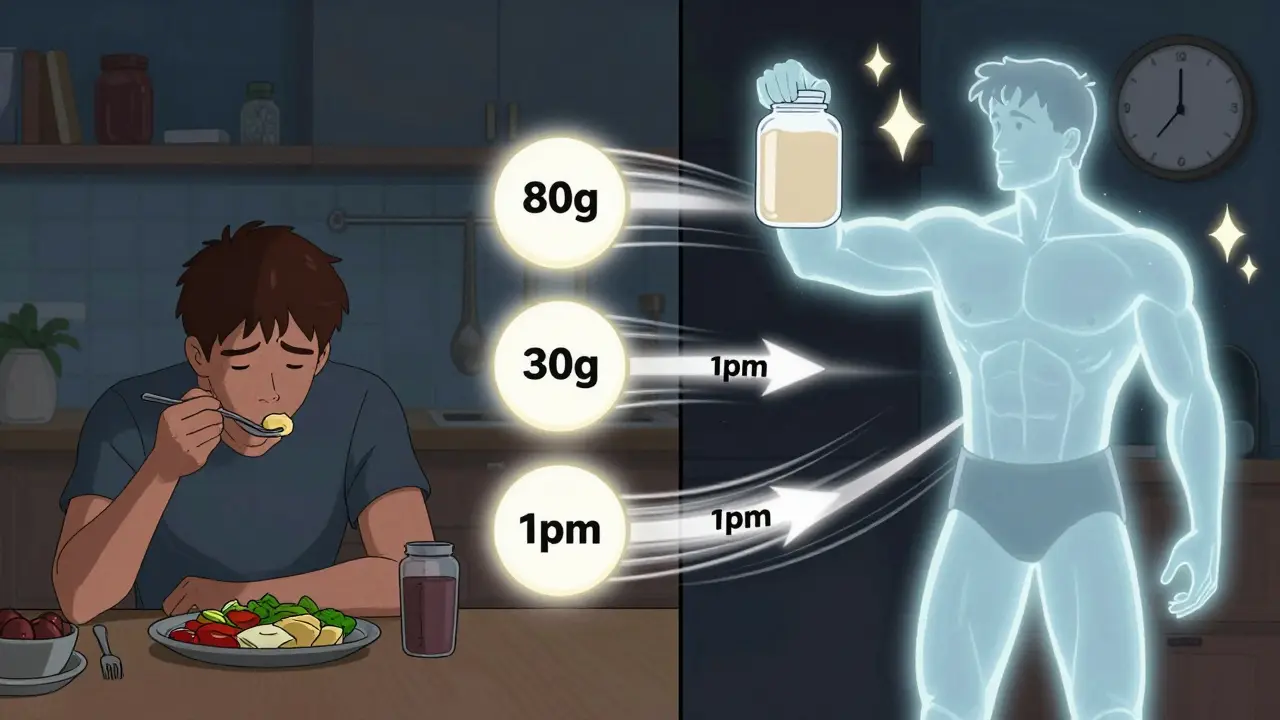
Here’s where most people mess up. They eat 20g at breakfast, 30g at lunch, and 80g at dinner. That’s a disaster for muscle. Your body can only use about 30g of protein in one sitting to build muscle. Anything extra? It gets burned for energy or stored as fat.
The real trick? Even distribution. Aim for 25-30g of protein in each of 3-4 meals. That means:
- Breakfast: 3 eggs + 100g Greek yogurt = 30g
- Lunch: 120g chicken breast + 1 cup lentils = 35g
- Dinner: 150g salmon = 35g
- Snack (optional): 1 scoop whey or 100g cottage cheese = 20g
That’s 120g total. Perfect. And it keeps your muscle-building machinery running all day. A 2022 study from Wageningen University showed people who spread protein evenly across meals preserved 2x more muscle than those who ate most of it at dinner.
Leucine: The Muscle Trigger You Can’t Ignore
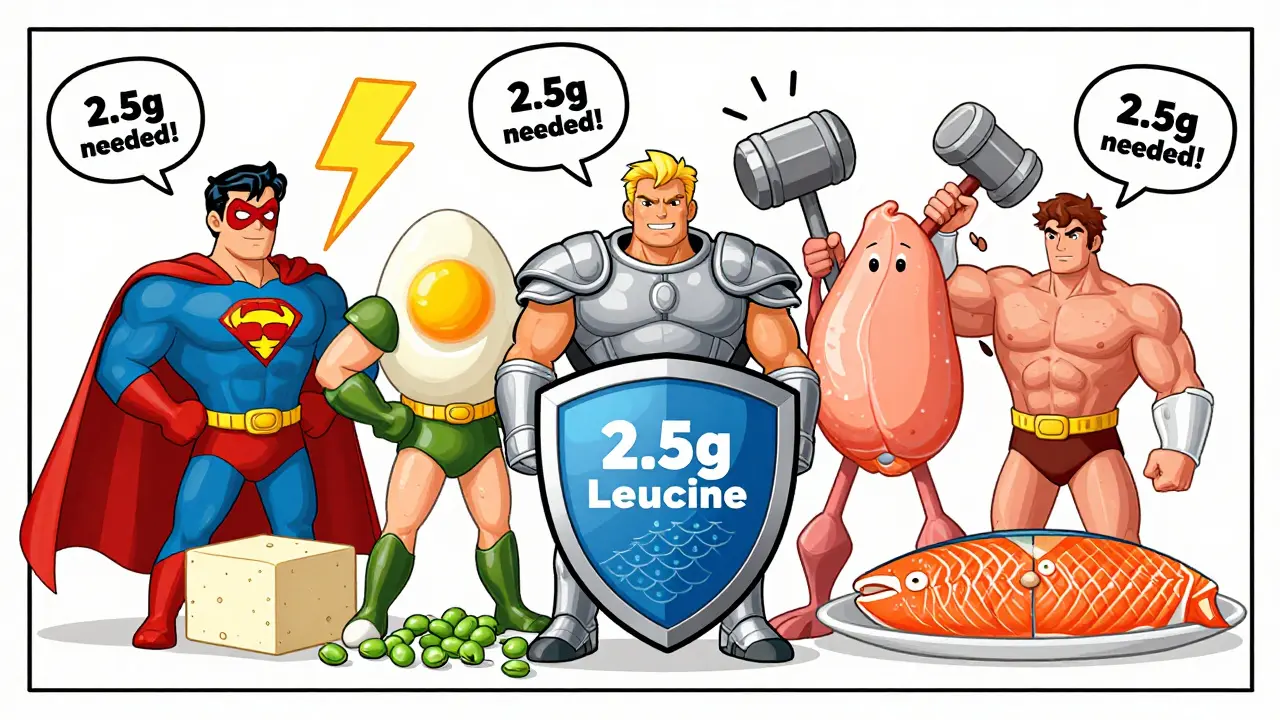
Not all protein is created equal. The key player is an amino acid called leucine. It’s the switch that turns on muscle repair. You need at least 2.5-3.0 grams of leucine per meal to fully activate muscle synthesis.
Here’s how much you get from common foods:
| Protein Source | Leucine (grams) | Notes |
|---|---|---|
| Whey protein | 2.8 | Best source. Fast-absorbing. |
| Eggs (3 large) | 2.6 | High quality, affordable. |
| Chicken breast (120g) | 2.4 | Great everyday option. |
| Salmon (150g) | 2.3 | Good for omega-3s too. |
| Lentils (1 cup cooked) | 1.2 | Plant-based - needs pairing. |
| Tofu (150g) | 1.4 | Low on leucine alone. |
Plant-based eaters? You need to combine sources. A meal with tofu + rice + pumpkin seeds gets you close to 3g leucine. Or add a sprinkle of leucine-fortified powder - some brands now offer it.
What Happens If You Don’t Prioritize Protein?
Let’s say you’re on a 1,500-calorie diet and you’re eating 0.8g/kg protein - the old RDA. You’re losing weight. Great. But here’s what you’re losing:
- Up to 40% of your weight loss comes from muscle.
- Your metabolism drops because muscle burns more calories than fat.
- You feel weaker. Climbing stairs gets harder. Carrying groceries? Forget it.
- Within 6 months, you’re likely to regain the weight - because your body now needs fewer calories to function.
Compare that to someone eating 1.6g/kg protein. They lose 90% fat. They keep their strength. They stay full. And according to the National Weight Control Registry, they’re 83% more likely to keep the weight off long-term.
Cost, Convenience, and Real-World Hurdles
Yes, protein is more expensive. Chicken, eggs, whey, fish - they cost more than rice, pasta, or bread. The USDA says high-protein diets increase food bills by about 18%. But here’s how to beat it:
- Buy in bulk. Frozen chicken thighs, canned tuna, and eggs are cheaper per gram of protein than fresh steak.
- Batch cook. Cook 500g of chicken on Sunday. Eat it all week. Saves time and money.
- Use affordable proteins. Canned tuna: $0.12 per gram of protein. Whey powder: $0.31. Eggs: $0.08. Lentils: $0.06.
- Don’t overdo it. You don’t need 200g of protein. 1.6g/kg is enough. More doesn’t mean better.
And if you’re getting bloated or constipated? You’re probably not eating enough fiber. Protein doesn’t cause constipation - lack of veggies and water does. Aim for 30g of fiber daily. Drink 2-3 liters of water. That’s non-negotiable.
Who Should Skip Protein Prioritization?
It’s not for everyone. If you’re sedentary and not trying to lose weight, 0.8g/kg is fine. If you have kidney disease, talk to your doctor before going above 1.2g/kg. And if you’re eating 2.5g/kg every day just because you saw a bodybuilder do it? You’re wasting money and possibly stressing your liver.
Also, don’t use protein as an excuse to cut out vegetables. Dr. David Ludwig from Harvard warns that replacing all carbs with meat and whey can mean missing out on antioxidants, fiber, and phytonutrients. Balance matters. Protein first - but not at the cost of your veggies.
The Bottom Line
Protein prioritization isn’t a diet. It’s a reset. It’s about eating smart so you lose fat without losing your strength, your energy, or your willpower. You don’t need to track every gram. Just aim for:
- 1.6g of protein per kg of body weight per day
- 25-30g of protein per meal, spread across 3-4 meals
- At least 2.5g leucine per meal - choose eggs, whey, chicken, or fish
- Plenty of veggies and water
- Avoid processed protein bars if they’re full of sugar
People who do this don’t just lose weight. They feel better. They sleep better. They have more energy. And they keep the weight off. That’s not magic. That’s science.
Is 1.6g/kg of protein safe for long-term use?
Yes. Studies tracking people for over 2 years show no negative effects on kidney or liver function in healthy adults. The old fear that high protein harms kidneys was based on people with pre-existing kidney disease. For healthy people, 1.6-2.2g/kg is safe and effective.
Do I need protein powder?
No. Whole foods like eggs, chicken, fish, Greek yogurt, and cottage cheese work just as well - often better. Protein powder is just a convenient option if you struggle to hit your target. Don’t rely on it as your main source.
What if I’m vegetarian or vegan?
You can still prioritize protein. Combine legumes with grains (like rice and beans) to get complete amino acids. Add tofu, tempeh, seitan, and edamame. Consider a leucine-fortified plant-based protein powder if you’re struggling to hit 2.5g leucine per meal. Studies show it’s possible - just requires more planning.
Can I eat all my protein at dinner?
You can, but you won’t get the full benefit. Your body can’t store protein like it stores carbs or fat. If you eat 80g at dinner, your body uses maybe 30g for muscle repair and burns the rest. Spreading it out keeps muscle synthesis active all day.
How fast will I see results?
You’ll feel fuller within days. Muscle preservation shows up in 4-6 weeks - you’ll notice you’re not getting weaker when you lift or climb stairs. After 12 weeks, people on protein-prioritized diets typically have 1.3kg more muscle than those on low-protein diets.




15 Comments
I tried this for 3 months and honestly? My energy went from 'meh' to 'I can climb stairs without panting'. I'm 42, female, and I stopped feeling like a zombie by lunchtime. Just hit that 25g per meal rule and boom - no more 3pm sugar crashes. Also, eggs for breakfast? Game changer.
This is just Big Protein pushing their agenda. They don't want you to know that meat companies pay scientists to say protein is magic. The real secret? Eat less. Period. Stop falling for the hype.
I appreciate the data, but the leucine table is laughably oversimplified. Anyone who thinks tofu + rice = optimal leucine intake is either delusional or hasn't read the actual studies from the Journal of the International Society of Sports Nutrition. Also, 'whey is best'? Please. Whole foods > supplements. And don't get me started on 'plant-based needs fortification' - that's a corporate workaround for poor diet design.
I've been doing this for 18 months now and I can't believe how much my life changed. I used to be a 120kg guy who couldn't tie his shoes without getting winded. Now? I deadlift 185kg. But here's the thing - I almost quit because I thought I was gonna die from constipation. Turns out, I was just not drinking water. Like, at all. I was chugging protein shakes and eating zero veggies. Then I started eating kale, broccoli, and drinking 3L of water daily. My gut cleared up. My skin cleared up. My mood cleared up. I'm not even joking - this isn't just about muscle. It's about your entire nervous system. If you're not hydrating and eating fiber? You're sabotaging yourself. And no, protein doesn't cause constipation. You do.
The 1.6g/kg recommendation is statistically sound, but it's not universally applicable. Individual variability in mTOR sensitivity, insulin resistance, and gut microbiome composition significantly modulates protein utilization thresholds. Furthermore, circadian protein distribution must account for cortisol rhythms and muscle protein synthesis peaks, which occur between 10:00 and 14:00 in most diurnal humans. The Wageningen study, while robust, excluded sedentary populations over 70 - a demographic that may require different dosing. Also, leucine thresholds are dose-dependent and nonlinear; 2.5g is the minimum, not the optimal. Peak synthesis occurs at 3.2g per meal in trained individuals. You're not wrong - you're just incomplete.
Okay, but what if you're broke? I work two jobs. I can't afford 150g of salmon every night. And I'm not gonna spend an hour meal prepping chicken when I get home at 10 p.m. You talk like this is a luxury lifestyle. It's not. It's a privilege. I eat beans and rice. I eat eggs twice a week. That's all I can do. So don't act like everyone has access to this 'perfect' diet. Your advice is great - if you have time, money, and a kitchen.
I'm a single mom in Lagos and I'm doing this with beans, groundnut paste, and canned sardines. It's not easy but it's possible. My son is 10 and he's stronger than half the kids in his class. We don't have fancy protein powder. We have love, consistency, and a pot. You don't need expensive stuff. You just need to try.
The leucine threshold is not 2.5g. It's 2.8-3.1g for anabolic signaling in skeletal muscle. The cited values are based on outdated 2017 meta-analyses. The 2023 meta-analysis by Chen et al. in AJCN demonstrated a sigmoidal response curve peaking at 3.0g leucine per meal. Also, whey is not 'best' - it's pharmacologically superior due to its rapid absorption kinetics. Plant proteins lack the leucine density and digestibility. This is not opinion. This is biochemistry.
The scientific evidence supporting protein prioritization is robust and well-documented in multiple randomized controlled trials. The recommendation of 1.6 g/kg/day is endorsed by the European Food Safety Authority and the International Society of Sports Nutrition. It is imperative to note that protein requirements are influenced by age, activity level, and health status. For elderly individuals, higher intake may mitigate sarcopenia. However, excessive consumption beyond 2.2 g/kg/day offers diminishing returns and may lead to unnecessary caloric surplus. Balanced nutrition remains paramount.
I’ve been vegan for 12 years. I’m 58. I lift. I feel strong. I eat lentils, tempeh, hemp seeds, and a little soy protein isolate. I don’t use powders. I just plan. It’s not magic. It’s rhythm. I wake up, eat, move, rest. My bones don’t ache. My joints don’t creak. My energy? Steady. You don’t need to be perfect. You just need to show up. 🌱
I hate how everyone acts like this is some revolutionary idea. I've been eating protein first since 2015. No one talks about the fact that most people don't even know how much protein is in a chicken breast. I had to teach my own mom. And she's 62. She cried because she finally stopped feeling weak. But now everyone's acting like they discovered fire. It's exhausting.
This is all part of the globalist agenda to make us dependent on processed meat and whey powders. Real food is plants. Real strength comes from nature. Why do you think the FDA allows this? Because they're paid off. You think eggs are good? Try eating a sweet potato with a spoonful of almond butter. You'll feel better. And no, I don't care about leucine. I care about truth.
I just started this last week. I ate 3 eggs and yogurt for breakfast. Felt full till 3pm. Crazy. I didn't even try.
I'm curious - has anyone tried this while intermittent fasting? I do 16:8. I eat all my protein in the 8-hour window. Does it still work? Or does the timing mess with the muscle synthesis?
To the person asking about IF and protein timing - yes, it works. I’ve coached 47 clients on 16:8 + protein prioritization. The key is to get your 25-30g within the first meal after breaking fast. Muscle synthesis isn't ruined by fasting - it’s just delayed. As long as you hit your daily total and distribute it across 2-3 meals within your window, you’re golden. Don’t overthink it. Eat. Move. Rest. Repeat.